By Gianni Postiglioni, Head Coach – Greece, FISA Coaches Conference, Budapest, Hungary 7-11 November 2007
Transcript by Jamie Croly
---------------------------------------------

Weight lifting in rowing is quite common, we have a lot of things in common, when I listen to Jurgen and also when I listen now to Adrian, I said what can I say more than them? It is possible because in rowing we are mainly talking about strength endurance and I have seen that the angle of Jurgen was very good and also the angle of Adrian was different from him, but a lot of things in common. It means that if we are leading and we are preparing different rowers the mentality, the approach to the problem is more or less the same. The only thing I am thinking here with Adrian that is doing things a bit different between my approach and his approach is that I am mainly coaching small countries and I don’t have the opportunities to speak with the specialists and have people making this, and I believe that this is the right way to do this with a specialist, but with the new sport in the future it means that we must have a psychologist, a specialist for weightlifting and maybe for biking or running or other sport activities, physiotherapist, doctor which means a big team. But we have qualified 4 athletes and we should have 10 people supporting them. It means for the sport federation that is a huge amount of money and it’s not possible to do it. And this way the small countries they say Ok we give up or we make an easier way for the system and we try to make our best because at the end I think we can find a good system but at the end it is the mentality of the rower, the motivation of the rower and this is the main point, they must be convinced of what they are doing. And I think that our duty as a coach is to make the things easy for them and not to complicate too much. And just to make things easy for the rowers this is my philosophy. To try to understand better the problems. Now about the weight lifting for lightweights.
I said to myself what is the problem? For my rowers to make more strength and mainly more endurance strength because this is the call(??) And I was listening that the weight lifting is also positive for Rene for injuries but I also see that there is a big risk for injuries with weight lifting so I don’t know if it works so well with preventing injuries. I know that we should build better the body of the athlete but when they make a squat as I have seen with the seniors in Great Britain with 150kg on the shoulders some repetitions 15 repetitions I think that this is a risk and we cannot prevent injury but we are looking for injuries. And I know that the technique and all these things are very important but we should go in the easier way and in this speech to you I will try to tell you what I think is the easy way that I want to apply.
I said to myself what is the problem? For my rowers to make more strength and mainly more endurance strength because this is the call(??) And I was listening that the weight lifting is also positive for Rene for injuries but I also see that there is a big risk for injuries with weight lifting so I don’t know if it works so well with preventing injuries. I know that we should build better the body of the athlete but when they make a squat as I have seen with the seniors in Great Britain with 150kg on the shoulders some repetitions 15 repetitions I think that this is a risk and we cannot prevent injury but we are looking for injuries. And I know that the technique and all these things are very important but we should go in the easier way and in this speech to you I will try to tell you what I think is the easy way that I want to apply.

First of all with the weight I want to have the goal and the goal is what I am looking for with this training methodology. I want to get something that I can read and the rowers they can read so that we cannot go there and lifting up and down many kilos for whole year. I think that the point is just start from this point.
 I think that one of the goals of strength is to see the strength and endurance from the velocity point of view. This is one example that Professor Bosco he has made in 1983 where two athletes are pushing a very heavy machine and between these two they have two different speed capacities. The one athlete is a slow athlete and the maximum speed that he can put power is at 5m/s. The quick athlete is at 10m/s is his maximum speed capacity for power and you can see that in the beginning when the velocity of the object is at zero both of them can pull together and its no big problem. At the beginning it doesn’t matter about the qualities of the way they sprint it is just the start but when they arrive at close to 5m/s we see the slow athlete is not really able to push together with the other because of his maximum speed and the other athlete is using more but when they arrive at the speed of 8m/s, before the maximum of the other one, the slow athlete is braking, he is not making propulsion, he is not pushing the load, but is braking the effect of pushing of the other athlete. The strength is important but it is also important to relate the velocity and the strength that you are producing. This means that what we should look for, we were talking about tall athletes, strong athletes but I think that we should also find the fast athletes because they can move faster in boats because fast twitch fiber or slow twitch fibers are very important from this point of view.
So we need special athletes but at the same time we need also to see find the points where we want to see our training working and the main points as we have seen in the picture in the first one, we can say that the point is that we should have one strength when we start which is the maximum strength and we need another strength during the base race and another at the end of the race.

Now which kind of test should we make with our athletes to measure the strength? Now the point of view that we are from in this room is that we maybe should make weight lifting test. Ok for this specific training is ok but I want to make the test that test that this training is helping my athletes to be better. I believe that the test we make to them are different and it means that I want to make three tests

At the start I want to see the energy that the athletes can make at the start and I think it is quite acceptable to make a test for 100-150m, more specifically we work on 150m.The test is on the pace race for 2000m and then we should see also how much they can increase the speed when they are tired, we see the change of speed in the last part of the race which means that we need to measure during the test for example in a 2000m their capacity of changing speed in the last part of the race. And I think that this is a very easy simple test to give to the athletes and measure during the season to see if they are able to increase these values or if they are not which is important because it means that we should review our training program because we should not accept 100% always the training program we are doing. We should criticize also our training program.

What I should expect from this test that can be done on the ergometer? With the start test I want to measure the maximum strength that they can apply to the boat or to the ergometer in this case. And we can say that the start is very close to the maximum strength with this kind of test. And then we can see endurance strength during the pace race. And in the last 100m we should measure the possibility for the change of speed in the last part of the race. I think that this is one very easy system. I a sure that there are some good biomechanists they can find even more sophisticated things but I told you we don’t have this possibility with our rowers and we must just stick in the very simple systems.

The methods to increase strength, because we are testing the athletes and now we want to see which methods we get.

I have seen for a very long time and reading around the question of strength and I make also the question to myself especially for lightweights do we need the strength, so we need to increases the strength of the rowers or not. I know that some colleagues from other countries they don’t make strength training in the gym or this is what they say around and this I can underrated because more strength is also very closely related to the body weight. And Adrian is right it is not only the tallest athletes but also the bodyweight is related to the strength. If you want to be stronger you must increase your body weight. But then there is a limit where it is not positive to go over this limit but we really don’t know where we can stop. Especially with the lightweights, I know where to stop, its 72kg with men and 59 kg with the women, this is very clear limit for everybody. And in one way this is why I think the level of the lightweights is so close between all of them because it is based on the weight. The limit of weight give the same possibility to fight and it is very hard to get medals or to reach the final between them. I think one difference that can be reached in this area is mainly the efficiency of the technique and with some rowers they have good seed we say speed capacity. To train them or to make them a little bit faster or make them more endurance because one of the goals we want to have with weight lifting training is to make more endurance for their fast twitch fibers. They will maintain their speed qualities for 2000m because this is one of the goals we want to have, to be fast on 2000m.

I was just looking and this is quite common that the weight lifting is one of the ways to increase the strength and there is not much discussion of this but one way to use the strength is the rowing ergometer ad this is part of the general training periodisation. In the past few years the speed has improved a lot and this is mainly from the new blades that they need more energy and more strength but also from the more often use of ergometer from everybody especially in the winter time and this is giving a higher limit of speed for the crews. Also rowing with the hydraulic break the bungee as Jurgen and Adrian told before but I just want to say something more about it. It should take under consideration that first weightlifting is positive you can increase the muscle mass and increase the power but we are not sure if we can transfer all this power all this energy and this strength we get to the boat. This is the main point. The rowing ergometer is more close to the boat but it is again not the boat. But when we are in the boat and rowing with the hydraulic break in this case we a re more close to what the rower should do ad I think this is the main training goal of coaches that they are using to maintain the low body weight of lightweights and trying to increase the specific strength they need on the boat. But with bungee I don’t trust so much to this training, Its good I use it but I prefer I don’t use it always because the rowers they loose the feeling of gliding of the boat and gliding is what is very important for us because they should maintain especially during the winter when we are getting new boat and trying to put together new rowers this kind of training is stopping our planning our teamwork and I don’t like too much this training. But is it better to use the rowing without crew, this is starting to be a much closer to the gliding and the feeling of the boat and to get the right feeling of technique and the connection with the boat, they should have the right connection with the foot stretcher or the transmission of movement from the arms and the legs to the boat.
But I know that it is possible in Greece, or in Spain, or in Italy but it is quite difficult to use this kind of training in winter with snow and ice as it means part of the crew is cold while the other ones are rowing or you can have back problems because you cool down too fast and so this training can have some negative effects. It is for the coach to decide which one is better for a period of the season. And the last one is heavy gearing on the oar. I think we are mainly talking about heavy gearing if we want to compare the weight lifting with more strength. We should use heavy gearing in the boat to get the feeling at the same time more rowers in the boat and they can try to increase the power or they can try this is one system to transfer the more energy they have been able to build in the gym to transfer this energy in the boat. Because I have always the view of weight lifting and transferring to the boat. Gym and boat, for me they are combined. We cannot have one view for the weightlifting and other view for the boat. We should have one line.
About the methods for weight lifting because I do not have specialist but I have been talking with some specialists and they are huge numbers of systems. I have been counting 21 different systems to increase the strength, one of the most famous one is the Bulgarian system, after I read about the system I see there should be some recovery of 48 hours, or 36, or 24 between one section and another one, but with this Bulgarian system they were training three times per day 45minutes 2 times each time and after this 3 times per day they repeat the same program more or less only with changing of speed for 7 days and working more or less between 90-95% of the maximum load. What can we say that there is little recovery but the Bulgarians we can see that they have been very successful. I don’t know if it was the training program or something else. This is something we cannot trust. But in any case in the same area in the same field there is very good fantasy to make program but one common point is that they are working in the first art of the metabolic capacity, it means that they are working in the anaerobic alactic or anaerobic lactic but very low. But this is just for the first part of training we can use in rowing this is the start, the first part is about 5-10% of our race but we should have a look more on the 80% of our race. It means that we should think about the training for endurance strength. It means that for rowers and mainly for lightweights I am not so interested to work with big loads and to increase the body mass, because this is quite dangerous.

Now I thin you know quite well Zatsiorsky, he was one of the first Russian writing on biomechanics, he is for me one of the base of biomechanics and he was telling that there are three methods to have the maximum strength tension; one is lifting not the maximal weight till exhaustion, this means the goal of exhaustion give the effect of lifting not maximum weights; the second is lifting the maximum weight that is 1, 2, 3 repetitions; and then the third one is lifting not a maximum weight but at the maximum speed, it means that the speed is connected within the system and this is one extra point we should take under consideration for the development of our rowers. I think with my rowers I prefer to have a look at the first one but the athletes are quite careful they don’t trust so much the system of weights, it means they want to be exhausted but their brain is their limit but the third one, they use quite good speed in their training I think is more close to what I want to reach. It means that I want to training the fast twitch fibers to be more oxidative and at the same time try to increase the power with the higher speed.
And this is one of the points I want to touch that the second and the third one they concentrate more on neuromuscular effect. It means that if the load is quite high you cannot go over a big number of repetitions, there must be a lower number of repetitions. The first one with exhaustion you can have higher number of repetition which means that we are more on metabolic effect that we should watch about the lactate in the body.
Now we have one picture that I want o just give you an idea. Strength Resistance and which other strength are converted and how can we reach the strength resistance because there is not only one way we can reach the strength resistance. At the base we have the maximum strength and explosive strength, initial strength, how the rower or athlete is starting the activity, and rapid strength, it means how quickly they can apply the strength. And then the second step is to reach the maximum strength resistance at the same time they increase from the rapid strength to the rapid resistance strength, and then the both of them the maximum strength resistance and the rapid strength resistance they can give the resistance of athletes. This means that when we make the weight lifting program we should not watch just from one side but how they make the exercise is also important, because during the exercise we would find different speed. One reason I do not agree, I make it but I don’t try to do it so much is the maximum strength with very few repetitions because that case it is true that you work on the maximum strength but at the same time you are very slow speed. It means that the strength is just mainly for the start, nothing else, but the speed is coming with other training methods that we see later.

How to make the efficient strength training. There are some basic rules, and I try to be simple. With so many things it is not always simple but perhaps with the exchange of opinion with the panel after my speech we can go more in detail if you like. First of all to the plan as I said before of efficient strength resistance training should be: Resistance to a movement higher than the race conditions, higher load I mean, it means the load should be higher than we usually use in the race. Because if we are working with the same load that we can apply in the boat there is no reason, we want to do something that is higher to get one benefit and transfer this extra strength to the boat. The second point is to repeat more times the training stimuli, it means that this training must be repeated many many times to get used to it and I want to say also that this is one way, especially during the winter time where we make aerobic and a very big volume of aerobic training it is one way to maintain active the production of lactate because if during the winter time we work only on very long aerobic training and we stay always below 4mmol for all winter and then when we want to start to make the race the athletes are not used to produce the lactate and the weight lifting program keeping high the lactate, that some research they are making in East Germany, I was talking to Theo Korner when he was technical director in Italy in the beginning of the 90’s they made very good research on weigh lifting and rowing and they are seeing as Jurgen said before there is a limit but it is not a limit of body weight or strength but a limit of lactate that the athletes they can produce during this training and they have tried at the beginning with 4mmol and then they have tries 9mmol for a period but then they said it should not be higher than 6mmol. This means that the level of lactate during weight lifting is important to get the right adaptation of the muscle fiber to the training and to combine the aerobic training with the anaerobic training in this case with weight lifting because if we produce too much lactate this can be an inhibition to the strength and the strength can give inhibition to the aerobic training. This means that the compromise of this research is around 6mmol. How can I say to you that this is 6mmol when I say to you I am not trying this with my thing but for me the number of repetition and the time that they are in training they use to me more or less an idea about the level of lactate because the rowers if they make 40 repetition or 30 repetition we should make sure we are not working around 20 mmol or 15 mmol because after 40 seconds they should stop and they should go on. The time that they use for training or the one set is enough that we can understand that we are below this rhythm and also the load. I was very surprised reading the level of strength they have reached, I mean in the former East Germany and I think not with other supplements.
Efficient strength resistance training should be connected with the race structure. As I said before I want o increase my endurance strength but watching to the speed of the boat, I want to be stronger but not slower. I want to be stronger and faster. And the target of this training should be the main muscle groups, agonist and antagonist. I believe that there must be both of them, not because we want to see a nice body but because the body is balanced between these two groups of muscles. The efficiency of antagonist muscle is not based only on the agonist muscles but is also based on the antagonist muscle because we should remember that if we want to be fats in the finish we must be fats to pull the boat but at the same time we must be fats also to go out of the finish, with the same speed we go in the body we should go out the body. Which means that we need well trained antagonist muscles and they can keep in balance the movement of the agonist muscles. At the same time there are some theories that say well trained antagonist muscles in that area they can help to reutilize the lactate you get. It means it is quite efficient to work also on the antagonist muscles.
One of the goals on strength resistance training is to do so with good control of physiological action of the body. What does this mean? As I said with the lactate we want to make our training with more metabolic effort and at the same time we don’t want to use too much of this training. It means that we can have quite close as Jurgen said 24 hours weight lifting training, if it is necessary we can do it but if we have too much lactate with very close training I don not think the athletes react very positively to this, it means we should put in balance the different strengths, maximum strength s with endurance strength.
And the last point is building points in Microcycles. I believe in working always on the weight lifting but giving change of stimuli, in strength not only changing exercise because I think changing exercise makes too complicated the life of athletes, and changing the exercise can loose too much time because on of the reasons of training, and the use of weight training is we ant to make better use of the time of athletes. We can get some results also quite close to this using other methodology, but they need more time and one of the reasons that the athletes they don’t like some training because its too long and they have other things to do, they want o have more or less normal life. It means that if we want o make a training plan for them we should not use a big number of exercises and big volume of training. Just give them the right things and building during the season the quality of strength and the quality of endurance strength and try to move together and balance these strength qualities you have reached during the year with the training program in the boat. This is quite complicated but it is our duty to put in balance for this effect. But I try always not to make compacted the life of athletes and just to make change and variation of the training program because it is easy for them. They dot need to think or have pain on the body, because if you change exercise I have seen very often they have a lot of pain just at the beginning and this especially in very stressful period is not nice.

Now we talk about deciding the load, how we decide the load for the crews or for a specific athlete. There are three, made by Zatsiorsky. The load can be found by the percentage of maximum load, it means that you make one repetition at the maximum and you say this is 100% and from this repetition you move down and you make the other percentage and you decide the percentage. Another system is to work normally with 10kg less than the maximum and decide the repetitions for 10kg less. And you can find the maximum possible repetition with the same load. And you decide the limit of repetitions of the maximum repetitions; the limit is not maximum weight but maximum number of repetitions. In this case you say no more than 20 if they try to make the maximum say 25 to 30 they should go back with more load. So these are the three systems that Zatsiorsky advised to find the right load for the weight lifting.

There is one table that I took from around, this specific one if from Bompa in1993, but there are many others of these tables and they have seen that one of these tables there one mistake is 75%(???) It means that they are very nice numbers with the 100% of maximum we can make 1, 95% is between 2 and 3, 90% is 4 and this curve, but the formula they find this curve they are not so exact. In fat you can find the rowers for example they make 1 repetition with 100kg but then they can make with 55kg 20 repetitions, what means this? The number of repetitions is the maximum weight that can be used as a reference is too much related to the technique of the athletes. Technique is a big limit of the system. This means that it can be better to have lower lad and make maximum number of repetitions because this is less dangerous on the athletes and we save from injuries on the back and at the same time we are more close to the endurance training that we are looking for. And based on the number of repetitions we can go the other way we can say ok you can make 2 or 3 or 4 repetitions just to work on maximum strength because we calculate that more or less your 100% is the other load but always being very very careful because for me this is a very dangerous area.

This are some common sense form Mr. Zatsiorsky and I took for you just to say in the field of weight lifting we can make many mistakes, sometimes we say ok the rowers are training and ok they are tired but they don’t increase the strength and the athletes in weight training with maximum capacity of a load for 25 repetitions as we said we find the maximum, if they work with 15 or 18 repetitions in this case they will never reach the critical position, they will never reach the maximum fatigue. Also in this case if they make big amount of load in the training we say 1000 repetitions in one period of training they will not increase the strength because to increase the strength you need a strong stimuli. If you don’t give a strong stimuli also to the endurance strength you cannot get the benefit out of it.

This is something that some of you were asking before to Adrian and also to Jurgen and is why we should continue to make weight lifting in summer. Jurgen and Adrian they were together agreed that the weight lifting should be continuous to very close to the most important races. Because athletes that train with high loads are used to high loads. If they don’t train to exhaustion, if they don’t train to the maximum in 2 months they will loose 5-10% of the maximum strength. This means that it is better that during winter time we build a lot of power and then with two months of stop we loose all this energy that we have made in the previous months.

Here is one aspect that is quite interesting to see. For me it is quite interesting to see. And I find on Comete a French researcher on muscle training for weight lifting and he say that between 1 and 3 repetitions we can have quite good development of size of muscles and with 10 repetitions we can have the maximum hypertrophy but when we go around 20-25 repetition we don’t have such big hypertrophy. This is one of the reasons with the lightweight I prefer to stay in this area. But I know that there are some other weight lifter experts that say in this are between the 15 and 20-25 repetitions you have hypertrophy. I believe also in this case because the difference in the system is the speed of how you make the exercise. If you are very slow you can have some effect on the muscles and you create hypertrophy. If you maintain some dynamic movement in training you will get less effect on hypertrophy. Otherwise I think it is quite evident that for example rowing is an endurance sport and if you make only rowing and if you pull a lot you will never build a big body like the body builders or weight lifters. Rowing needs the support f weight lifting to increase the body mass. Only with rowing is it not possible. I see many heavyweight rowers that make only training with the boat, they are not able to maintain their body mass of muscle. They reduce. If the continue to make weight lifting their body mass stays high.

Another point that I want to highlight on this is the velocity related to the load of the athlete. You see in the first example we move the force curve with the strength with heavy very maximum training the force curve adjusts on the top. It means that on the very heavy load at the beginning we can be faster but then the speed is going down when we go on endurance. In inexperienced athletes (far right) they start the activity with some strength and in any case they move the curve from the start point with the training effect. At the same time if you make medium load you can move the center of the curve but this is not what we want. We should decide which area of the curve we want to have. And I think that in rowing we need to move the lower part, which means that we increase the force with high speed and this is the goal that we want to meet in rowing (bottom right). And at the same time if it is possible to move the beginning at the start and try to move it more in front. This area from my point of view for lightweights is quite dangerous because we are pushing more on hypertrophy.

Now on hypertrophy. I think that as a lightweight we should have a look and we should know quite well this effect. And somebody say that hypertrophy is only an aesthetic effect. But we see with the example I don’t think that it is only an aesthetic effect but with some specific training yes.

This picture we see the muscle mass of training which relationship it has with hypertrophy. We can have different hypertrophy that depends from how the work and how we make the training. First of all we can have structural training and this training is training with very low numbers of repetitions, but this training has an effect on the muscle mass. But muscle mass can have another two sides, one is the sport muscle mass; it means that athletes they need more strength and this effect is called sarcomeric hypertrophy. It means that it works straight on the muscle fiber. It means that you get the muscle fibers bigger. But hestetic muscle mass works on sarcoplasmatic hypertrophy. It means that the size of muscle is much bigger because the plasma that is in the muscle cell will increase in volume. And to get this effect is not so much connected with the muscle fibers but more with the environment where the fibers are. And it is not that we say, and this is bodybuilders, it is not true that they have no capillaries, they have lots of capillaries and you can see watching their pictures they have huge big veins, it means that this system it also works on the capillaries, but the question is how is the efficiency of the muscles, which speed or rate they use to build the muscles in this way. I’m sure it’s not a dynamic movement and I’m sure that they move exactly in the movement of muscles to get this specific effect. You should not make confusion with improvement of muscle mass of athletes when they make the weight lifting in the gym, because also in rowing we see that during the weight lifting especially on the legs they increase the muscle mass. This something that Wilmore and Costill they call transitory effect of hypertrophy. It means that especially in the legs there is an edema, there is an inflammation and this inflammation attracts water and this effect will stay for some hours but after we finish will not stay for a long time. The bodybuilders they work on this and they use it to make the show just to get good size of muscle just to improve before they go out. But this is one effect that in our athletes it can happen but just for limited time.
The cognitive training is something related to the central nervous system and especially in the maximum strength the main goal is not metabolic but is mainly neuromuscular. It means that cognitive training to get this effect is more related to the central nervous system, that you need different recovery for this training effect with the weight lifting.

As I told you before we have hypertrophy that is transitory that is just for the moment that you are doing the training but is can also be chronic, it can be sarcoplasmatic and sarcomeric. Sarcomeric is the good on for sport. Then we have two other possibilities that are coming from the different ways to make the exercise. One is in parallel and the other one is in series. In parallel is increasing the tension and the section of the muscles transversally and in series is increasing speed and muscles longitudinally. What means this? That if you make one complete squat for example you make the maximum length of the muscle in this case you will get the series effect which means that you will work on the maximum length of the muscle. But if you work with a smaller angle for example say 90 degree with higher load you work in parallel which means that you work on increasing the section of the muscle. Again I can tell you for the lightweights we are not so much interested in working in parallel because if we work on this section we can have more hypertrophy and training in series is more in the direction of speed and to increase the power with big angles of the legs and the other muscles of the body.

The training with weightlifting has one effect on the muscle fibers. You see this is one system of training with sub maximal loads. Sorry for the Spanish but this was the only one with quite nice picture I could find to show you this effect. We see that on this upper part (upper left) we see that there is a motor unit with fast fibers and down (bottom left) we have the slow fibers. The motor unit with light circle in the centre they are the muscles that are recruited for the effort, and the big circle with white centre they are the fibers that are recruited but not tired and the dark circle are the fibers that are recruited and are tired. You see that when the load is sub maximal load you have one phase where the number of fibers is totally recruited but very few of them are recruited with effort and at the middle of the number of repetitions we see that there are 50% recruited and tired but there are another 50% that are recruited but not tired. But when you are exhausted, and this is the reason why you should always reach the limit of your repetitions, when they are exhausted you see that all fibers are recruited and very few fibers are recruited but not tired. With maximum load (right column) you see that very few fibers are tired but all other fibers are active but not tired because the number of repetitions is so slow and low that they have no time to be tired. It means that you work well and you work with intensity but you don’t give the best possibilities to the fibers to get the best out of the training of strength training.

Here we have again Zatsiorsky and this is giving his idea about hypertrophy and its say that you can get hypertrophy from both sides with 8-10 repetitions but you can also have hypertrophy with 1-3 repetitions. But with 1-3 repetitions the possibility of hypertrophy is very low and with 8-10 repetitions it is much higher. The reason for this is for high number of kilograms that you move with8-10 repetitions because with 100% of the load you can say that it should be around 66-75% you can get very high mechanical work. In this case you will have a lot of catabolic training and from this super compensation, from this super compensation you can have hypertrophy. The low mechanical work that you can have with 1-3 repetitions gives less protein breaking and you can have less hypertrophy.

Now from the point of view of a weight lifter and people that want to increase just the strength this is a table that you will get with my material. And this maximal work is very high to 4-7 repetitions, medium high 8-12 and then you get medium, poor and very poor. For endurance strength we should be in this area (19-25) which is very poor for maximum strength but is quite good from my point of view to reach the strength that we need.


I want to say some words about the rest and stretching because one of the reasons that I was telling poor countries was that you should avoid going to see the physiotherapist because we don’t fund it and at the same time we should have the right recovery from the effort. The main recovery for endurance with the low percentage of loads will be short recovery but if you work mainly on the neuromuscular effect it means that you have few repetitions it should have higher recovery. The recovery between training sessions, from one day to another day should be more than 24hrs. I think also for endurance.

The exercises that we use in rowing that I said to you are quite basic. We have more or less the same exercises that Jurgen explained to us and I want to put very good attention on this exercise (good mornings) and this exercise (hip extension) because these are very simple exercise but at the same time they are very important active muscles of the pelvis because these muscles are very important for, in this case to prevent injuries to the athletes. And all the others they are the normal ones that we use in rowing. We try t be very close to the movement of rowing.

This is the training that we usually make with our lightweights. We have functional training that is based on this number of repetitions. I said to you that I prefer to stay more close to 7 than to 10 just t not get hypertrophy and we use it for a limited period of the year. And then we have power that is between 20-25, we have the circuit that it very dynamic activity that is around 25-30 and we have endurance training with weightlifting that is even lower than circuit, the speed is a little bit lower but they need to make more repetitions.

I want to highlight about the core area muscles and they are abdominal, low back and hip muscles. This part is not so well followed, I have seen many times because the coaches think that it is lost time and for the athletes it is too easy an exercise.

But if you see what we need these muscles to act as shock absorbers, they are very important to stabilize the body and this group of muscles they represent an important link to transmit between the legs and arms. All the effects of using the arms and legs are going by this group of muscles. They are so important that they should never be forgotten in the training preparation.

 Short talking about the periodisation or planning, we can see in the weightlifting, from Kramer, we have some variation during the season during the preparation phase the first transition, competition phase and then at the end the transition phase. You can see that all year we can use the weightlifting. Only very close to the race do we reduce the weight training.
I just from Tudor Bompa take some suggestions about how to help the athletes to grow. Which muscles they should work in puberty. The hips and the shoulders and the core area also. In the second part post puberty the stabilizers and all rotatory muscles. In the adolescence they should work on the stabilizer muscles, make annual periodisation, and then after 20 year when they are mature physically they can work on annual periodisation and be more specific. I think this is a good point of view for weight lifting because it’s not saying you make weightlifting and go and make squat but think about the physical and transmission point and form this you can go over to others.

This is one example of what we are doing with our lightweights. This is the preseason block where we work on resistance then we work on maximum strength and then on functional training. We combine together the effect of this training.
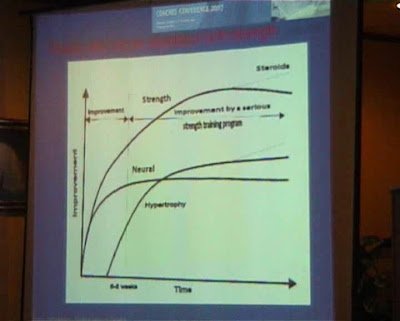
At the end I want to show you this progression of strength and hypertrophy. This is quite famous because in the last part to have a gain in strength and gain in hypertrophy you need steroids. I wanted to show you this because in rowing we would never go in this position because this is mainly specific training where the athletes would never reach such high levels, especially in hypertrophy because force training is part of our training, it is not the main part of our training. But what is interesting is that in the beginning what gives the most effect on the strength is the neural development. It means that the central nervous system has a big involvement in this and we should watch it because from my point of view this is the key point to develop strength and to improve the capacity of rowers to be more adapted for a good technique. Technique can be well related to this development of neuromuscular weightlifting with rowing.


