Showing posts with label running. Show all posts

Saturday, December 1, 2007

Olympic Marathon – Anatomy of a Medal

Olympic Marathon – Anatomy of a Medal
By Joe I. Vigil, Ph.D.

---------------

One of the most compelling success stories of the Athens Olympics was the performance of the U.S. Team in the Marathon. These outstanding performances were the result of not only exceptional talent and discipline on behalf of the athletes, but impeccable planning and application of 21st century sports science.

This article deals not only with the application of science and training methodology, but also the athlete/coach interrelationship, vital for the success in any athletic endeavor. Although Team Running USA had two medalists in the Marathon – Deena Kastor (Bronze) and Meb Keflezighi (Silver), this article will deal with the specifics of the training progression of Deena Kastor.

This success was not an overnight achievement. It started 20 years ago when Deena’s involvement in age group athletics first started. From the very beginning, she showed signs of things to come. After winning several California state high school championships, she enrolled at the University of Arkansas. Her collegiate career was good but not exceptional. She earned several “All American” recognitions in both Cross Country and Track & Field, but she never won a national championship. The outstanding talent she displayed as a high school runner was never realized in college.

I first met Deena when she competed for the U.S. Jr. Cross Country Team in the World Championships in Aix Le Baines, France. In our first meeting, we developed an instant mutual respect. I learned that at the completion of her University of Arkansas studies, Deena found herself with a burning desire to continue her training. Like most, she dreamed of one day running in the Olympics and, at the urging of her Arkansas Assistant Coach, Mylan Donley, she contacted me. At first I was reluctant to work with her, but her persistence, hunger for high goals, and willingness to relocate to Alamosa, Colorado (7543¢ altitude) persuaded me to take her on. Hence, a team was formed.

Qualities Necessary for Success
I believe it was the best professional move either one of us has ever made. Her accomplishments the last eight-ten years (1996-2005) have been spectacular. The qualities necessary for this level of success and the progression of her physiologic profile came at a great price.

As with all members of Team Running USA, we required that all athletes strive to:
Improve Personal Relationships
Improve Achievement Motivation
Improve the Quality of Their Mini and Macro Environments
Improve Their Athletic Maturity
Show Integrity to Their Value System
Display a Commitment to Their Mission
Practice Abundance by Giving Back to Their Sport and Team

If I were to operationally define the qualities an athlete must possess to be successful, Deena would epitomize those qualities. She is a great example of mind/body autonomy working in harmony to reach set goals. She truly believes and adheres to the principle of unending improvement and the setting and achieving of even higher goals.

Increases in Volume
Knowing that I had an athlete willing to go the extra mile, we started working on the physiologic variable that would allow her to compete at the international level. Previously, she was only running 40-50 miles a week, which certainly was not enough volume to compete at her desired level. We increased that volume to 70 miles per week (MPW) for the next 15 months. This allowed for gradual adaptation without any resulting injuries or setbacks. At this point, she had a VO2 MAX of 70.2 mls. (VO2 MAX is the maximum amount of oxygen in milliliters your body can use in one minute per kilogram of body weight, i.e. the higher the better). We next increased her volume to 90 miles a week over the next 18 months. Her VO2 MAX jumped to 77.5 mls. During this time period, she was making her mark nationally and had won a national championship in Cross Country. Again, we increased her volume to 100-110 miles per week and, not surprisingly, her VO2 MAX was at 81.3 mls. This level of fitness is attained by very few athletes and is one of the highest ever recorded in an American athlete.

Presently, we maintain an average of 100 mpw ±10 and adjust that volume in accordance with the competitions she will enter. The volume can be as low as 70 mpw for track races to 140 mpw for a marathon. Because of our precise planning, she handles this volume manipulation very well.

We both knew VO2 MAX was important, but even more so was the increase of anaerobic threshold (AT - the point at which lactic acid starts to accumulate in your muscles). Since this became an important training objective, we incorporated the AT runs, sometimes referred to as tempo runs. We started with four miles and over a period of time, increased to six, eight, and ten miles. If we were preparing for a marathon, she would run 12-13 mile AT runs. We thoroughly believed that the longer the run, the greater the stress, the greater the consequent adaptation.

A noticeable observation was made over the five-six year period of increased volume; her AT velocity increased profoundly. She went from an initial 5:24 per mile pace to 5:11 to 5:01. I would like to state that volume runs, when combined with a regular diet of AT runs, are the most important workouts for the development of the endurance component. This brought about a profound increase in her running economy.

Equipped with these two remarkable qualities (increased VO2 uptake and increased anaerobic threshold), any athlete can then embark on running and competing at the international level. We must keep in mind that these increases were brought about through gradual adaptation to stress. As we worked together on a day-to-day basis, Deena learned to listen to her body and knew exactly what her perceived exertion was at a given pace.

Training Priorities
After each human performance test, we had accurate information on her velocity at VO2 MAX (vVO2), anaerobic threshold velocity (ATV), lactate max, lactate at threshold, max heart rate (HR Max) and heart rate at threshold velocity. Armed with this information, we got her vVO2 (which was 4:27 for the mile). This figure would help us in determining her goals for the 3000, 5000, 10000 and the Marathon. We also determined that her fractionalization (VO2 at threshold velocity divided by VO2 MAX) was a percent we would like to improve. We followed the protocol below in determining goals:
3000 Meters 7-12 Minute Effort 100% vVO2
5000 Meters 13-17 Minute Effort 95% vVO2
10000 Meters 26-38 Minute Effort 90% vVO2
Marathon 2:06-2:30 80-85% vVO2

This information was deemed extremely accurate, as Deena was only off two seconds in her AR in the 10000 and Meb1.93 seconds in his 10000 AR. After determining their fractionalization (Deena 83% and Meb 81%), we established their goals for the Marathon. Again, Meb missed it by only three seconds and Deena by only 1 minute 16 seconds. Our objective for the future will be to increase fractionalization by utilizing volume and AT runs at the appropriate distance and velocity.

Altitude Training
The record has shown that since 1968, 95% of all Olympic and World Championship medals from the 800 through the Marathon were won by athletes who lived or trained at altitude. It can therefore be concluded that altitude training is necessary for success in endurance events. I have lived all my life at altitude in Alamosa, Colorado (7543¢) and it was easy for me to become a true believer in altitude training. The observations I have made and my background in physiology has shown me that there is a distinct advantage to altitude training.

Over the past 30 years, I have hosted individuals and entire federations for their altitude training. The successes include World records, Olympic medals and personal bests. Most of the distance running world has bought this philosophy. It has, however, been difficult to convince most American coaches and athletes, though there are a few that believe.
When Team Running USA was organized in 2000, Bob Larsen and I were hired to run the program. We both believed in altitude training and incorporated three-four altitude training blocks of one month or longer in our annual training plan. We selected Mammoth Lakes, California (8000-10,000¢) as our official high altitude training camp. We also tried to hold our camps prior to major events so they could go down to sea level with the greatest amount of oxygen carrying capacity possible.

Deena had spent four years (1996-2000) in Alamosa when we made our move to Mammoth Lakes, CA. The next four years (2001-2005) gave her a greater adaptation to altitude and she was capable of training at even high altitudes (9000¢), which she did frequently. On occasion, we would go to sea level to train at ARCO OTC in San Diego. This was also the site for all of our testing protocols. We were, however, altitude-based the majority of the time.
By living and training at altitude, athletes expect to get an increase in their red blood cell mass and hemoglobin, which enhance the athletes’ oxygen carrying capacity. These factors allow the athlete to perform and train more effectively upon return to lower elevations.
Olympic Event Decision
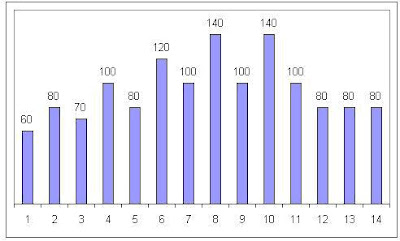
Upon consideration of all the negatives and positives of the geophysical conditions we would encounter in Athens, 11 months prior to the games, Deena decided on the Marathon. I believe she could have done as well had she selected the 10000 meters, but her choice proved to be a wise. We began by running Olympic Trials for protection against injury. This way she would be assured of making the Olympic Team. She decided to dedicate 11 months to the best and most difficult training she ever had, as well as competing a minimal number of times. The focus for the year was to medal in the Marathon. She, along with her three training partners, Colin Steele, Joe Eckerly and Derek Tate, put together 14 weeks (See Table 1) of excellent training that produced a fitness level she had not previously experienced.

Table 1.This table illustrates progression in weekly volume. It can be utilized by more experienced marathoners who can handle the increased volume.

Critical Zone Training
Critical Zone Training (CZT) is a phrase coined to identify training requirements for success at the Olympic Games, World Championships or specific high quality events. The training demands are specific to the event and incorporate the times athletes must achieve in practice to be able to compete at the above levels.


The average times in the Marathon for the previous four Olympic Games and five World Championships were 2:26:45 for First, 2:27:34 for Second and 2:28:16 for Third. Our goal was to medal, so we had to train to achieve these times under all conditions. The topography of the Marathon course in Athens is shown in Figure 1:

Figure 1: Profile of Athens Olympic Marathon Course

One can observe the torturous eight-mile incline from 18000 meters to 31000 meters. I found a very similar course close to Mammoth Lakes, where nearly all aspects were identical. The one difference was that it was at 7000-8000¢ altitude. We ran it seven times prior to Athens at a pace that was altitude-adjusted. The course in Athens presented no psychological barrier for Deena.

To meet the extreme demands of heat and humidity, we did three things:
We wore extra clothing in practice.
We practiced on fluid intake on our long runs every 15 minutes for 11 months.
We went to Crete two weeks prior to the Games to acclimate to the heat and humidity.

While training in Crete, we encountered extremely hot weather, always around 98°-104°F. We adjusted our workouts by running hard early in the day and easier in the late afternoons. As the days passed by, we progressively moved the intense workouts toward the time that the Marathon was going to be contested. Crete is in the same time zone as Athens, so our circadian rhythms had 14-17 days to adapt to the time zone of the competition. Constant reinforcement in hydration, rest and diet was carried through to the end.

As expected, the temperature at race time was 102° (120° asphalt) and 54% humidity at 6pm. As with other marathons, Deena knew she was going to have to exercise complete emotional control throughout the race. This is a quality she displayed beautifully, as the race results indicated.

Deena’s support team included her husband, Andrew (Physical Therapist) and three training partners. In Figure 1, the last 14 weeks shows her volume and taper prior to the race. The daily sessions of ancillary work (core, plyometrics, strength, flexibility) and agility drills over a number of years made her an exceptionally well-prepared athlete. Our specific training program consisted of the following training intensities:

Training Intensities
Basic Speed/Power: From 60 to 100 up to 400M speed endurance. Below 200M, all out at 300-400M race pace early. Then pick up pace with each repetition. This workout aids in the development of running form, running mechanics and event-specific running economy.
Lactate Threshold: Training runs of 20-60 minutes at 85-87% of HR or 85-87% of vVO2 aids in developing a high level of aerobic threshold.
High-End Aerobic Endurance: Endurance training at 70-80% of maximum HR or 75-80% of vVO2. The duration of runs should be 30 minutes to three hours. The runs should be on soft surfaces and hills. Negative split effort is most desirable.
MVO2: Development of maximum volume of oxygen at 90-95% HR or 90% of vVO2. Three minutes to eight-ten minute duration or repetitions of 800, 1K, 2K and 3K. We use two minute intervals between repetitions at sea level and three minutes at altitude. These runs develop peripheral training adaptations, increase fat metabolism, increase concentration of aerobic enzymes, mitochondria and capillarization.
Recovery: Low intensity runs 25-30 BPM below lactate threshold HR. The runs are from 45 minutes 1 hour 20 minutes and can be run both in the AM and PM. It promotes recovery following high intensity workouts. This run energizes the athlete for the next hard workout.

It is extremely important that the athlete and coach orchestrate the Five Training Intensities so they have proper recovery and maintain enthusiasm for the challenges to come. Table 2 exhibits the plan we employed:


THE RACE
I was not able to go to the starting line because of the traffic and crowd controls. In my last conversation with Deena before race time, she confided in me and said, “I have done every workout you have prescribed over the last seven months. I feel fitter than I have ever felt and I am confident that I will medal today.”

Along with her many supporters, I went to the historic Panathinaiko Stadium, home of many famous marathons, to watch the race unfold. As I sat and watched, I recalled all her training sessions throughout the previous 11 months as well as her volume (40,000 miles of training) the previous eight years. I, too, was confident she would medal. We watched on the giant TV screen as she moved progressively from 28th position to 3rd, running courageously, methodically, with confidence and emotional control.

To work with an athlete of the caliber of Deena Kastor comes once in a lifetime, and I have enjoyed every minute of it. Her Bronze medal was certainly a highlight of the Games for the American Team and legions of American distance runners back home. The biggest impact into the future will be the courage, the work ethic, her passion for the sport and the leadership she displayed on her memorable journey.

This showed that Americans, with proper training, are as good as any runners in the world. Young American runners in their developmental stages will try to emulate her and now know that their dreams and visions are realistic and possible, for they too can medal in the Olympic Games. Thank you, Deena.

Tuesday, May 8, 2007

Race & Sport

Race and Sport: The race to the swift - if the swift have the right ancestry
By Jon Entine
From www.pponline.co.uk.
-
Let's start with a few safe predictions. All of the sprinters in the men's 100m final at the Athens Olympics in 2004 will trace their ancestry to West Africa. Almost all of the world-class throwers will be white, and mostly of Eurasian ancestry. And, except for the marathon, there will be almost no athletes of Asian ancestry appearing in Athens finals. On the other hand, elsewhere in the Games, Asians will flourish in diving, some gymnastic events, judo, and table tennis.

A peculiar but decided trend is unfolding: over the past 40 years, as equality of opportunity has steadily increased in sports, spreading to vast sections of Asia and Africa, equality of results on the playing field has actually declined. The more democracy on the playing field, the less at the finish line. On the one hand, the social and economic barriers limiting participation in sports are crumbling; on the other, the winners in many events are increasingly limited to participants from specific regions of the world.

It's not surprising that the United States would dominate peculiarly American sports such as basketball, but who can fathom the trends in world sports, such as running. Why is it that every running record from the 100m to the marathon is held by an athlete of African ancestry? Is it racist to be curious about such phenomena?

Nature versus nurture
Absolutely not, say a growing chorus of geneticists, anthropologists, and physiologists. 'Very many in sports physiology would like to believe that it is training, the environment, what you eat that play the most important roles in sports,' states Bengt Saltin, director of the Copenhagen Muscle Research Center and one of the world's premier sports medical researchers. 'But based on the data, it is 'in your genes' whether or not you are talented, or whether you will become talented. The extent of the environment can always be discussed but it's less than 20-25%.'

To many sociologists, however, even discussing these trends trivialises the success of all athletes, but most pointedly blacks. 'What really is being said in a kind of underhand way,' insists Harry Edwards of University of California at Berkeley, 'is that blacks are closer to beasts and animals in terms of their genetic and physical and anatomical make-up than they are to the rest of humanity. And that's where the indignity comes in.' Ellis Cashmore of Staffordshire University dismisses the role of 'special inborn ability' as 'absurd, especially when we consider anthropologists' dismissal of the concept of race itself'.(1)

For many years, such righteous dismissals seemed like the moral and scientific high ground and a bulwark against the historical tendency to misuse genetics to support theories of white superiority. Ironically, today, with a far more nuanced understanding of the relationship of population genetics and environment, the formerly righteous position has become untenable - and even, in its own way, racist.

Do cultural factors matter? Of course: there are no great international cricketers from Texas - black or white! Does that mean that nature - genetically influenced (though not determined) factors such as body size and physiology - are always trumped by nurture - hard work and opportunity?

To help answer this question, let's briefly examine the history of distance running. For decades, the 'Flying Finns' were the world's best, their wins multiplying in tandem with their growing nationalist tradition of success (a situation replicated in the javelin - see page 6). The Finnish were eventually eclipsed by the great Anglo tradition in running, led in the 1980s by Sebastian Coe, Steve Cram, and Steve Ovett. By the last decade of the 20th century, as the door of opportunity opened to less developed nations, the centre of gravity shifted dramatically and decisively toward North and East Africa.

According to some, that cycle of history itself suggests that no population has a lock on distance running success. Surely, they say, Kenyan dominance will eventually fade, much as it did for the Finns and Brits, and the trend will shift once again to another nation?

Not so fast. To flesh out this debate, it's instructive to put Kenya under a microscope. This small East African country, with a population of less than 30 million, is home to the greatest per capita concentration of raw athletic talent in the history of the world (see map on page 5). The national sport is the passion of the masses. Little boys dream that one day, they might soak up the cheers of the adoring fans that regularly crowd the stands at the National Stadium in Nairobi. The best players are national icons. The selection process to spot the great stars begins at a very young age. Coaches backed by government money comb the countryside to find the next generation of potential athletes. The most promising of the lot are sent to special schools and provided extra coaching. It's not an exaggeration to call Kenya's most popular sport a kind of national religion.

According to conventional and socially acceptable wisdom, this is a familiar story - the sure cultural explanation for the phenomenal success of Kenyan distance runners. There's only one problem: the national sport, the hero worship, the adoring fans, the social channelling - all these relate to Kenya's enduring love affair with football! Despite the enormous success of Kenyan runners in the past two decades, running remains a relative afterthought in this football-crazed nation.

Yet, while Kenyans and other East Africans sweep upwards of 60% of the world's distance running events, they are among the world's worst football players - and sprinters. Despite an elaborate school system and the expenditure of vast amounts of the country's sparse sports resources, Kenya has flopped in trying to replicate its wondrous distance running success in football. In the sprints, after an intense decade-long national recruitment and training effort, the best Kenyan time ever in the 100m (10.28 secs) ranks somewhere near 5,000th on the all-time list.

So where does that leave the sociological argument that nurture trumps nature? Does anyone really believe that Kenyans, known for their legendary tough training regimes, suddenly become softies when the distance is 100m rather than 42,195m?

No amount of political correctness can obscure the reality that East Africans have a very distinct genetically endowed body type and physiology. Kenyans are ectomorphs, short and slender, with huge natural lung capacity and a preponderance of slow-twitch muscles, the vital energy system for endurance sports. It's a perfect biomechanical package for distance running, but a disaster for sports - like sprinting and football - that require anaerobic bursts of speed.

Science certainly does not support the popular notion that Kenyans prevail in distance running because they train harder or run huge distances as kids - myths frequently peddled by the media. For every Kenyan athlete who runs 100 miles a week, there are others who get along on 30, and did not regularly run extraordinary distances as children. 'I lived right next door to school,' laughs Kenyan-born Wilson Kipketer, world 800m record holder. 'I walked, nice and slow.'

Though individual success is indeed largely about opportunity and 'fire in the belly', when it comes to the patterns that we see in sports, genetic traits proscribe possibility. While a driven Kenyan could potentially transform himself into a decent sprinter in spite of having the ideal genetically endowed body type of a distance runner, thousands of years of evolution have left a distinct footprint.

'Kenyans and other East Africans are born with a high number of slow-twitch fibres,' notes Saltin, who outlined his widely-embraced findings in a cover story, 'Muscles and Genes', in Scientific American last year(2). The bio-cultural epicentre for world-class distance running - where evolutionary factors and social conditions come together in a feedback loop - is the Great Rift Valley adjacent to Lake Victoria. This is home to the Kalenjin, a loosely named population of 1.5 million people, who win almost 40% of major international distance events. One tiny district, the Nandi, with only 500,000 people - one-twelve-thousandth of the planet's population - sweeps an unfeasible 20% of such races.

While Kenyans and other East Africans hold more than 60% of the world's top endurance times, athletes of West African ancestry, including most North American, British and Caribbean blacks, are among the world's worst distance runners. The ectomorphic body type so common among East Africans is not very common in whites and is almost non-existent in those with roots in West Africa. They tend to have small and efficient lungs, muscular 'mesomorphic' lower bodies, and a high proportion of fast-twitch muscle fibres which contribute to explosive speed.
This is an exceptional biomechanical package for sports requiring fast bursts of effort. West African ancestral populations represent about 8% of the world's population, 12% in the US, and a mere 2% in Britain - but are vastly over-represented, especially when social and cultural factors are taken into account. Twenty-five per cent of England's Premiership footballers, 84% of American basketball players, 70% of US footballers, and 40% of baseball players are blacks of West African ancestry. The figures in sprinting are even more overwhelming: in the 100m, the purest test of speed, blacks of West African ancestry hold the top 220 times and 494 of the top 500 times. Yet, while runners of West African descent win upwards of 95% of the elite races (not all of course - human variation and individual drive ensure there are no guarantees in sports), there is not a single elite distance runner from West Africa.

For the nurturist argument to prevail, one would have to believe that British and American blacks are hard-training sprinters but lazy distance runners; or that they respond to financial incentives in the 100m but shrug at the prospect of six-figure fees and purses in elite distance races.

In other words, all the determination in the world cannot turn 100m champ Maurice Greene into a first-rate marathoner - or Kenyan distance runner Joseph Chebet or Moroccan Khalid Khannouchi into a world-class sprinter.

Frankly, such claims that blacks succeed for cultural reasons diminish the reality that sports achievement is all about individual accomplishment, that 'fire in the belly'. It's hard work, courage and serendipity that separate champions from other elite sportsmen and women.

Consider Michael Jordan, who grew up in the security of a two-parent home in comfortable circumstances. Or one of the world's top sprinters, the Canadian Donovan Bailey, who was certainly not motivated by a desperate need to escape destitution: he already owned his own house and a Porsche, and traded life as a successful stockbroker to pursue his dream of Olympic gold. More and more top black athletes are from the middle class.

Why is the success of blacks and other minorities such as Aboriginal Australians explained away by cultural channelling? Sports success is too complex a phenomenon to be tidily settled by such facile sociology. How do we explain the success of the majority of athletes, of all nations and ancestral heritage, who live in comfortable circumstances? The classic argument that blacks succeed in sports to escape poverty is less and less plausible and more and more racist every day.

Genes may not determine who are the world's best runners, but they do circumscribe possibility. Kenyans and other East Africans have an innate capacity, not an innate ability, to thrive in distance running; individual effort and courage separate the pretenders from the stars. Success in sports is a bio-social phenomenon.

Rethinking race, science and sports
Why does the claim that sports success depends in part on genetics get some people so nervous? After all, it's conventional science that different body types have evolved in response to differing environmental conditions in different regions of the world. The elephant in the living room, of course, is 'race'. Fascination about black physicality and black anger about being caricatured as lesser human beings have been part of the unspoken side of the dialogue on race for hundreds of years. The fear is that some might conclude that if blacks are faster on average, they must, as part of zero-sum reasoning, be weaker mentally. But that's a conclusion not supported by science.

What have scientists documented? 'Evolution has shaped body types and in part athletic possibilities,' says Joseph Graves Jr, an evolutionary biologist and author of The Emperor's New Clothes: Theories of Race at the Millennium. 'Don't expect an Eskimo to show up on an NBA court or a Watusi to win the world weightlifting championship. Genes play a major role,' adds Graves, himself an African American.

What does that mean? After all, the fact that significant differences exist between populations would seem to conflict with a spate of declarations proclaiming that 'humans are 99.9 % the same' and 'race is biologically meaningless'. Indeed, the arguments by Edwards and Cashmore rise (or in this case, fall) from such beliefs.

The paradox revolves around a common misunderstanding about the notion of 'race' - in particular, the popular notion that races are discrete groups, each with distinct genetic profiles. Race is a term soaked in much folkloric nonsense. The concept of race is somewhat akin to an omelette masquerading as an egg. It's a pretty messy concept, sometimes referred to as 'fuzzy sets' or extended families.

Despite its notorious history, racial terminology can be helpful, such as when used in medicine. Many traits are correlated, such as dark skin colour and the presence of the sickle cell gene. But such links are not absolute. Blacks who have evolved in cooler climates are no more likely to contract sickle cell than are non-blacks. Genetic factors help explain the prevalence of any number of population-specific diseases and physiological responses to drugs. Tay-Sachs is a neurological disease more common among European Jews and their descendants. Northern Europeans are more susceptible to cystic fibrosis. Blacks are genetically more susceptible to any number of diseases, including sickle cell and heart disease. These are all 'racial' differences of a kind, although the interaction of genetic and environmental factors is extremely complex.

With these many exceptions in mind, no serious scientist would subscribe to the dogma that grips the post-modernist sociological community. Today, no credible scientist disputes that evolution, along with local social conditions, has helped shape Kenyan distance runners, white power lifters, with their enormous upper-body strength, and athletes of West African ancestry who are explosive runners and jumpers. In discussing basketball, for instance, Jared Diamond, the UCLA physiologist and Pulitzer Prize winner (for Guns, Germs and Steel), writes that the disproportionate representation of African Americans is not because of a lack of socio-economic opportunities, but on account of 'the prevalent body shapes of some black African groups'.(3)
Most scientists are quick to point out that this is not a 'black and white' issue, but the consequence of thousands of years of evolution in varying terrains. Modern humans are made up of overlapping, soft-edged genetic clusters. Although humans share most of their estimated 40,000 genes, there are as many as 500,000 gene components, or single nucleotide polymorphisms (SNPs), many of which are more common among people from one geographical region than from another.

'The fact that monolithic racial categories do not show up in the genotype does not mean there are no group differences between pockets of populations,' stresses Graves. 'There are some group differences. We see it in diseases. But that's a long way from reconstructing century-old racial science.'

Each sport demands a slightly different mix of biomechanical, anaerobic, and aerobic abilities. As a result of evolutionary adaptations to extremely different environments that became encoded in the genes, athletes from different insular populations tend to have rather distinct physical and physiological characteristics. As a result, they frequently excel in specific events.

Whites of Eurasian ancestry, who have, on average, more natural upper-body strength, predictably dominate weightlifting, wrestling and field events, such as the hammer (whites hold 46 of the top 50 performances). Evolutionary forces in this northern clime have shaped a population with a predilection toward a mesomorphic body type - large and muscular, particularly in the upper body, with relatively short arms and legs and thick torsos. These proportions tend to be an advantage in sports in which strength rather than speed is at a premium.

Certain East Asian populations tend to be small with relatively short extremities, long torsos, and a thicker layer of fat - part of the evolutionary adaptation to harsh climes encountered by homo sapiens who migrated to Northeast Asia about 40,000 years ago. As a result, athletes from this region are somewhat slower and less strong than whites or blacks, but are, on average, more flexible. These characteristics are key potential advantages in diving, some events in gymnastics (hence the term 'Chinese splits'), and figure skating. They also have very quick reaction times, which undoubtedly contribute to their success in racket sports (see case study 2 on page 9). And though they generally are not very competitive at jumping and sprinting because of squatter bodies and the predominance of slow-twitch fibres, East Asians are very competitive at long distance races, including the marathon, in part because of higher levels of body fat. It should come as no surprise that the world's most remarkable ultra-endurance runners, the 4,000 or so Native American Tarahumara of Mexico, have East Asian ancestry. (The Tarahumara are considered the least-assimilated people in the Americas; like the Nandi, they subsist by herding, agriculture and hunting. They also love to run: it is not uncommon for women to run up to 40 miles as part of social game-playing.)

Popular thinking still lags behind the genetic revolution. Genetically linked, highly heritable characteristics such as skeletal structure, the distribution of muscle fibre types, reflex capabilities, metabolic efficiency, lung capacity, and the ability to use energy more efficiently are not evenly distributed among populations and cannot be explained by known environmental factors.

'Differences among athletes of elite calibre are so small,' notes Robert Malina, Michigan State anthropologist and editor of the American Journal of Human Biology, 'that physique or the ability to fire muscle fibres more efficiently that might be genetically based... it might be very, very significant. The fraction of a second is the difference between the gold medal and fourth place.'

Although scientists are just beginning to isolate the genetic links to biologically-based differences, it is indisputable that they exist (see 'Genetic engineering and sport' - page 9). Such characteristics are not distributed equally among populations. The genetics revolution has decisively overturned the belief that all humans are created with equal potential, a tabula rasa for experience to write upon. Some functional characteristics do differentiate population clusters - most clearly in the proclivity to certain diseases and in body types.

Why do we so readily accept that evolution has turned out groups with distinct susceptibilities to different diseases - yet find it racist to acknowledge that blacks of West African ancestry have evolved into the world's best sprinters and jumpers and East Africans into the best distance runners?

In light of recent advances in genetics and the science of human performance, extremist claims that we should not discuss these 'racial' or patterned biological differences appear quaint, dangerous and perhaps even racist. Limiting the pejorative use of that problematic concept of race - an admirable goal - is not going to make the patterned biological variation on which it is based disappear. Although people share a common humanity, we are different in critical ways.

The question is no longer whether genetic research will continue - but to what end. Athletic competition, which offers a definitiveness that eludes most other aspects of life, is a perfect laboratory for a serious exploration of the complex relationship of genes and culture.

'I believe that we need to look at the causes of differences in performance between races in sports as legitimately as we do when we study differences in diseases,' says Canadian Claude Bouchard, sports physiologist and geneticist, and director of the Pennington Biomedical Research Center at Louisiana State University. 'I have always worked with the hypothesis that ignorance fosters prejudice. (Critical inquiry) is the greatest safeguard against prejudice'

Indeed, if we do not welcome the impending genetic revolution with open minds, if we are scared to ask and to answer difficult questions, if we lose faith in science, then there is no winner; we all lose. The challenge is in whether we can conduct the debate so that human diversity might be cause for celebration of our individuality rather than a source of distrust.

Finally, it should never be forgotten that genes are not the ultimate factors in elite performance. While genetics will determine if you have a chance to be an elite athlete, intelligence, dedication, and serendipity are the final arbiters of who wins and loses.

'It's the brain, not the heart or lungs, that is the critical organ,' Sir Roger Bannister told me on a visit to his home at Oxford University. 'But one would have to be blind not so see a pattern here. I hope we are not at a time and place where we are afraid to talk about remarkable events.'

Jon Entine