Barbie Doesn’t Play Sports
By Tim Wakeham
http://www.training-conditioning.com/2007/03/barbie_doesnt_play_sports.htm
-------------------------
How can you get female athletes to embrace their weight-room workouts and throw away their desire to look like thin fashion models? The keys are to listen, understand, and educate.
"Do you want to be a runway model or a healthy competitive athlete?" I have asked this question to many female athletes. I ask the question because, when I listen to their words, they say, "I want to be strong and explosive." The problem is that when I listen to their actions, some say, "I want to look like a thin fashion model."
One of my goals as a strength and conditioning coach is to inspire my athletes to do progressively more work in the weight room. The combination of progressive overload with the genetics of most competitive athletes eventually results in a small increase of lean body mass. Research suggests that increases in lean body mass begin around week six. But it is common for the female athletes I coach to stop by my office for a meeting long before week six.
Meetings usually start with, "Red, I am worried that I am gaining weight and getting too big." I sometimes want to smile because I know that a majority of women do not have the genetic predisposition for Ms. Olympia-size muscles, and certainly they won't be showing increased muscle mass by week three. I don't smile, though, because I know that body weight and cosmetic shape are no laughing matter for most females.
The conflict between the duty of strength coaches to increase lean body mass in female athletes and many females' desire for social acceptance through thinness can be a difficult issue. How can strength coaches deal with this tug-of-war? In this article I'll offer some specific strategies I use at Michigan State to motivate our female athletes to embrace improvements in lean body mass.
LISTEN, ACKNOWLEDGE, TEACHWhen it comes to most issues, the more communication you can share, the less the conflict. Communication on this issue starts with the strength and conditioning coach acknowledging how focused many females are on slender shape and social acceptance, as opposed to physical competitive readiness.
Listening to female athletes over the years has been an interesting education for me. The biggest surprise has been how much time and energy they spend thinking and talking about food, diet, body weight, and cosmetic shape. For some women, these topics are a constant preoccupation. Based on my experience, I believe that if four female athletes went out for lunch to discuss a team issue, each could recount what the others ate and how they looked in their clothes with greater clarity than the topic discussed.
This may seem silly to a coach who thinks about body shape, oh, maybe once a year when he has to put on that suit and tie for the year-end awards banquet, or who comes from a football background where bigger is better. That's why it's important to commit to hearing and understanding females' thoughts and feelings regarding their desire for thinness. This is the first step to making a connection from which they will listen, trust, and commit to our goals and plans.
Along with listening to my athletes and acknowledging that they may constantly struggle with body image issues, I try to teach them why this problem exists. Females are taught from a very early age that attractiveness, acceptance, personal happiness, and self worth are based on a very thin shape. The message is simple: If you are thin, you will be confident, well-liked, and successful. They see it in every advertisement, women's magazine, and celebrity photo shoot.
I educate my athletes that they are being sold this unrealistic body ideal by marketers pushing products. The diet, fashion, and cosmetic industries take advantage of female body image insecurities through the promotion of an "ideal" body shape. The ideal shape is usually small muscled and thin. This distorted social norm is then linked to an extensive list of products to make your "perfect body" dreams come true. It is important to teach female athletes awareness about this deceit and how they are being manipulated.
Furthermore, it is not uncommon for fashion models' and celebrities' pictures to be digitally altered. In 2003, GQ magazine buffed, trimmed, and altered actress Kate Winslet's photos in order to flatten her stomach and thin her legs. Winslet said the editors reduced the size of her legs by a third. Cover and photo shoots are often the culmination of weeks of personal preparation—along with professional lighting, make-up, costume design, air brushing, and computer manipulations.
It is unrealistic and unwise for women to use these fantasy advertisements as role models. This is especially true for athletes, whose goals are health and triumph, not product sales. But the reality is that it's extremely hard for females to ignore all these images.
So we talk about the issue. I listen attentively to the female athlete who wants to talk about her fears, no matter how many times I've heard the same story. I try to empower each young woman by educating them on how the body image phenomenon has arisen. And I try to teach them that confidence and acceptance comes from within.
At the same time, I tell them not to give themselves permission to succumb to these unrealistic social pressures. Rather, they should embrace their genetic gifts and physically prepare to dominate. Changing their focus is their challenge, and I tell them I believe in their ability to do so.
FEARS VS. FACTSWhen women are afraid that strength training will cause them to bulk up and dramatically change their body size, one of the best things I can do is provide them with scientific evidence that this is probably not going to happen.
I start with this: Studies show that over a nine-week period, most women who engage in resistance training gain a little over one pound of lean body mass, while experiencing a corresponding decrease in body fat of just under two percent. I usually repeat that. A mere one pound!
Females who weight train may see muscular size increases of 20 to 30 percent, depending upon body type and other genetic factors. However, increases do not appear to meaningfully affect external girth measurements, because they simultaneously lose body fat. Of two studies reviewed, one showed no overall change in girths and the other showed less than a quarter of an inch.
Research clearly shows that a majority of females will gain muscle and lose fat while staying close to the same body weight and size. For most females, the meaningful result should be a more shapely and taut physique.
I also tell them about the benefits that can be derived from weight training. A properly designed and implemented weight training program may contribute to increases in strength, speed, endurance, and flexibility. Further benefits include a decrease in the chance and severity of musculoskeletal injuries and increases in psychological well being. Finally, because muscle is a metabolically active tissue, small increases in lean body mass through weight training may lead to a higher metabolic rate (more calories expended during both exercise and recovery) and potentially less body fat.
SMART EATINGMany female athletes who are afraid strength training will make them too big also fear that eating adequate calories to fuel their workouts will lead to unwanted weight gain. So another important method of ridding female athletes of their fear of gaining weight is to give them a constant flow of nutrition education.
We talk a lot about the benefits of eating a variety of wholesome foods throughout the day and immediately following exercise. I explain how doing so can provide a constant flow of energy, delayed onset of fatigue, enhanced healing of injuries, faster recovery from illness, improved concentration, and enhanced athletic performance. Ultimately, the benefits of healthy eating probably give athletes a competitive edge without spending more time practicing.
To assist with nutrition education, we recently hung four 32-inch flat screen television monitors in our weight room. We have the monitors hooked into a computer that continually runs a nutrition PowerPoint presentation throughout the day. Each slide then answers one nutrition question or presents one important nutrition fact. For example, one slide answers the question, "Why shouldn't you restrict caloric intake?" while another explains how to make great food choices. The PowerPoint idea has worked extremely well to educate our athletes without taking up any extra time.
We also educate them about what constitutes healthy and unhealthy eating in a psychological sense. Because we want to avoid disordered eating, we teach them what it means to have a balanced approach to meal planning.
For example, smart eating can include refined sugar and foods with fat. Many dietitians suggest eating your favorite "fun" foods in moderation as part of a balanced, nutrient-wise plan and as a strategy to keep from binging.
An example of an unhealthy eating attitude is the habit of labeling foods "good" or "bad." Female athletes should not shudder at the offer of a cookie or small bag of chips. High-caliber female athletes should feel relaxed and comfortable eating a wide variety of foods. Calories from the "bad food" list have no greater influence on weight than do the low calorie items from the "good food" list. A calorie is a calorie—weight gain results from going over your total caloric needs. What is needed is balanced meal planning.
I encourage balanced eating through both motivation and education. I motivate by first establishing a relationship of trust and loyalty to both the person and the athlete. The women I coach know that I care about them personally and am passionate about their athletic goals. They know this because I show up, inquire, listen, and try to understand them personally before professionally solving and leading. Then, I try to motivate them by sharing exchanges about the joys and purposes of eating. When the athletes and I talk there is little judgment, just education and some laughs.
I also try to demonstratively celebrate those who are healthy eaters in front of the group. I tell stories about champions and championship teams I have worked with who committed to purposeful eating and benefited because of it. I also remind athletes of the times they were successful because of proper fueling or failed because of their lack of healthy eating.
Furthermore, I practice what I preach. The women know that I generally fuel myself with healthy foods, but they also know that my "fun foods" are Little Debbies and Gummies.
When I hear athletes say, "I am having one brownie after I get done eating a balanced plate that consists of a rainbow of wholesome foods … and, yes, I did eat breakfast!" I know we're making strides. I give them a high five and a big smile.
MEETING STANDARDSAt the same time, we make it clear that our goals in the weight room are to increase their strength and lean body mass. We acknowledge reality around body image, but we also invoke standards and apply them through consequences and rewards.
Because many females are not that excited about the prospect of lifting weights and getting stronger, they tend to need more incentives than male athletes. Many females want to start with five pounds on each side of a bar or machine and progress by just two and a half pounds. This would mean we wouldn't arrive at a challenging resistance or improve body composition until a week before they graduated.
To ensure that our females are challenging their muscles, I assign the standards of "DF" meaning "demonstrated fatigue" and "NF" meaning "not to fatigue" next to all of the prescribed exercises. The effort level assigned to each exercise depends on the degree of technique involved. Low technique exercises have an NF assigned to them instructing athletes to stop when the goal repetition is achieved or technique significantly breaks down. DF means female athletes must continue to lift until they achieve demonstrated fatigue. Demonstrated fatigue means continuing until exercise technique is significantly affected or the player cannot achieve a repetition without assistance from her partner. DF's inspire trainees to start with a challenging weight load so they don't have to lift a weight 50 to 100 times before they reach DF and are allowed to stop.
Progressive improvement on both DF and NF exercises is also a measured standard. If athletes fail to meet these standards after being taught, reminded, and reinforced, they are told to leave the weight room for the day and their name goes on a "Throw Outs" list that is posted in the middle of the room. Those who do attain the standards are demonstratively celebrated and treated like the heroes they are.
A MATTER OF BALANCEJust as it is important to individualize strength and conditioning prescriptions, it is sometimes important to acknowledge aesthetic demands of the sport and how this affects body image. For example, if we are working with a naturally muscular and strong gymnast (mesomorph), we may decrease weight training volume and address higher priority rate limiting factors like explosiveness or flexibility. Additionally, if we are working with a slightly stocky wide framed diver (endomorph), we may decrease total quantity of weight training and add anaerobic conditioning to address the aesthetic requirements of her sport.
But, for the majority of the athletes we train, we build bodies with the goals of enhanced performance potential and reduced chance and severity of injuries, and we don't worry about whether or not the body is attractive. We empathize and work with those females who feel dissatisfied with their bodies. However, we do not compare athletes to the standards talked about in the general public, and we do not try to solve the "my muscles are too big" problem unless it legitimately exists.
To explain our focus, I sometimes tell a story about one female non-athlete and one female athlete who were eating at a local restaurant. When the non-athlete female was asked what she was doing she replied, "I'm eating lunch." When the female athlete was asked, she replied, "I'm building a champion."
Selfless commitment to team victory is our main focus. To accomplish it, we individualize sport-specific programs so that our athletes can safely and dominantly perform their sports skills. To this end, we listen, learn, educate, and lead.
At Michigan State, exercise is a tool for fitness, fun, health and victory, not weight control or body downsizing. To the Spartans, the weight room is a place to experience the joy of team interaction, connection, and accomplishment—a place to celebrate the strong, powerful, fit female.
Sidebar: ON THE LOOKOUTMost of the athletes I work with respond to the approach I describe in the mainbar of this article. Some are even enlightened by it and gain new confidence. But a handful do not hear what I'm trying to say no matter how much we talk. So I also am constantly on the lookout for athletes who have begun a cycle of disordered eating.
At the end of a hard week of training, I once asked an exhausted female athlete, "What have you been eating this week?" She replied, "Cereal." When I said, "Cereal and …" She replied, "Milk." That's right, she ate nothing but cereal and milk for five days straight.
Disordered eating often starts with restricted caloric intake and includes bizarre eating habits. Restricting whole food groups is an example of disordered eating, as is making very strict rules about what or where one eats. Other examples of behaviors that set off alarms include having an intense fear of weight and size gain, a constant preoccupation with food and thinness, a perception of being overweight when nothing could be further from the truth, significant weight loss, denial regarding significant weight loss, infrequent or absent menstrual periods, constant guilt regarding eating, always eating alone, and excessive exercising.
Disordered eating can create a variety of secondary problems, including insufficient intake of vitamins and minerals, low energy, impairment of immune function, reduced strength, poor motor control, fatigue, menstrual irregularities, or the loss of menstrual periods altogether. If untreated, loss of menses can lead to poor bone health, stress fractures, and premature osteoporosis.
Eating disorders can take the forms of anorexia and bulimia. Dangers associated with these situations can include loss of teeth and hair, heart conditions, kidney dysfunction, liver trouble, and even death.
People who have reached this point of being at war with their body don't need to be blamed. They simply need help in the form of professional guidance and treatment. When I see any signs of disordered eating, I communicate with our sports medicine department, which has an outstanding system of professionals in place to help athletes with eating disorders. The sooner a person can be treated, the more quickly she can overcome the issue.
Sidebar: SAYING YES TO LESSLast year one of my women's teams asked to do less work at a point in their off-season training. They said they were not physically recovering and were feeling mentally burnt out. I believe in listening and responding to the troops, so I did lessen the workload.
However, the team asked for less volume multiple times. I started getting frustrated because I secretly wondered if they were doing their part. Were they being responsible eaters for the goal of recovery? Did they have a rejuvenation plan? I suspected they were eating for appearance and not being professionals regarding their mental rejuvenation. In response, I researched and wrote a two-part test that I now hand out to people who ask to do less. If they can answer yes to at least 80 percent of the questions on both parts of the test, I consider reducing the volume of training. If they score less than 80 percent, I do not lower the planned workload. Below are the test questions:
Part I: Physical Recovery Test
· Do you eat breakfast every day?
· Do you eat and drink every three hours regardless of whether you are hungry or thirsty?
· Do you rest, via night sleep or a combination of night sleep and naps, between 7.5 and 8.5 hours every day?
· Are a majority (60-65%) of the foods that you eat carbohydrates (whole grains, fruits, vegetables)?
· Do you eat a balanced variety of foods to ensure adequate levels of sodium, potassium, calcium, and iron (bananas, meats, milk, cheese)?
· Is the color of your urine always light yellow?
· Do you drink at least two cups of water or sports drink two hours before and immediately after practices and competitions?
· Do you drink at least eight 8-ounce cups of caffeine-free nonalcoholic fluids every day?
· Do you drink one-half to one cup of water or sports drink every 15 minutes during practices and competitions?
· Does a majority of your dining plate look like a rainbow (filled with red, orange, yellow, and green foods)?
· Because alcohol affects metabolism, sleep, hydration, and your need for certain vitamins and minerals, do you abstain or strictly limit your frequency and amount?
· Do you consume calories during practice (one-quarter or one-half piece of fresh fruit, 3-4 pieces of dried fruit, 10-12 Teddy Grahams, 5-6 vanilla wafers, one-half an energy bar, one-quarter cup sports drink??
· Do you eat a combination of both carbohydrates and protein within 15 minutes of cessation of activity (practice and weight training)?
· Do you choose more wholesome and natural foods rather than heavily processed and refined foods?
· Do you increase the amount of food you eat per day during times of increased training?
· Are you menstruating? If you are not, is there a valid medical reason?
If you cannot answer "yes" to at least 13 of the 16 listed questions, we do not want to lower the frequency or volume of your training. Our experience demonstrates that you are choosing to do less than is your responsibility in order to win consistently. Organize and commit yourself to smart recovery strategies in order to fully ignite your talents and abilities. Stronger energy management skills can be the difference for you, your team, and your dreams.
Part II: Mental and Emotional Recovery Self-Test
Have you planned and taken mini vacations that allow you to "disconnect" from your sport personality and "reconnect" with other parts of who you are (your creative, adventurous, and fun sides)?
Have you planned and used daily "time-outs" when you can relax your mind and calm your emotions? Common time-out activities include naps, meditation, yoga, and deep breathing.
Do you have a list of activities that help you totally disconnect from your sport so that you are able to come back to it refreshed and hungry?
Do you implement some of your disconnect activities as part of your daily, weekly, and monthly rituals? Positive rituals are more successfully implemented when they are scheduled at the same time and on the same day every week. This way, you do not have to try to squeeze them in. Your positive rituals should be as common as waking up and brushing your teeth.
Do you keep a daily schedule to help you manage your time?
Do you delegate authority and responsibility to those around you?
Do you have realistic goals?
Do you exercise patience in your expectations of results?
Do you focus on success?
If you cannot answer "yes" to at least seven of the nine listed questions, we do not want to lower the frequency or volume of your training. Our experience demonstrates that you are choosing to do less than is your responsibility in order to win consistently. Organize and commit yourself to smart rejuvenation strategies in order to fully ignite your talents and abilities. Stronger energy management skills can be the difference for you, your team, and your dreams.
Tim "Red" Wakeham, MS, SCCC, is Assistant Strength and Conditioning Coach at Michigan State University. He is starting his 10th year at Michigan State and can be reached at: mailto:wakeham@ath.msu.edu.
Monday, January 28, 2008


Coaches as Leaders
Coaches as Leaders
by Robert E. Baker and Christopher Nunes
http://www.canadiansport.ca/newsletters/october/coachleaders.cfm
--------------------
Leadership is a concept that is often discussed but frequently misunderstood. Literature in fields ranging from business to education to sport examines the concept of leadership, but often fails to provide a pragmatic outline or blueprint for those in leadership positions. This article describes leadership strategies that coaches can employ to improve their own as well as their team's effectiveness. The strategies examine leadership from both a personal and organizational perspective. It is only when coaches critically examine their own leadership styles that their individual skills and abilities improve, and result in enhanced team performance. While the strategies described were written with coaches in mind, they are relevant to other sport leaders, such as athletic directors and team captains.
Plato once noted, "The first and best victory is to conquer self" (in Maxwell, 1999), and as coaches we pursue victory. While one never completes the task of conquering self, the pursuit of one's own growth and development is key. Coaches can facilitate their own success by attending clinics or conferences, giving presentations, taking classes, reading professional literature, staying on top of current trends, pursuing certification programs, and learning from other top performers in the field.
Using Jerry Rice as a role model, Rick Pitino (1997) stated that "... what is important is that I take the essenceof what makes him successful and incorporate that into my philosophy." Coaches should look to individuals who have achieved high levels of competence and success. These role models can be found not only in the sport arena, but also in other professions. Ideal candidates have effective communication, decision-making and conflict management skills; they are able to appreciate the needs and goals of others. While adopting the strategies of successful leaders is effective and essential, each coach must determine what is consistent with his or her own personality and circumstances. Some techniques used by coaches at the professional level may not be applicable to coaches teaching in an academic environment.
Coaches should utilize their power to accomplish the goals and objectives they set for, or with, their team. They should have good interpersonal skills in order to foster relationships that go beyond name, rank and serial number. They can do so by employing an open door policy and being empathetic listeners. They will also need to strike a balance between personal and professional relationships. If balance is weighed too heavily on the personal, coaches may not be objective enough to critically evaluate a player's performance. Or, the coach who develops a friendship with a player's family may be conflicted when a disciplinary action is required. A player may also attempt to take advantage of the relationship to promote a personal agenda. Well-balanced relationships encourage players to work toward team goals consistent with the coach's intent.
While it is preferred that coaches consciously work to enhance their verbal skills, they communicate with others on less conscious levels. As humans, we all communicate by our personal appearance, actions, body language, pitch, tone, rate, inflection, emotion, volume, silences and pauses (Qordan, 1996). Communication is also multidimensional, so one must consider people, environment and circumstances in interpreting messages. An effective leader's messages "...are simple and direct and can serve as a battle cry of sorts for people across all organizational levels" (Carlzon, 1997). It involves sending clear, appropriate messages, reducing extraneous distractions, responding to feedback, selecting the correct channel, and actively listening. In order to ensure that messages are received as they are intended, coaches need to evaluate their own communication skills. This can be done by employing feedback from others (i.e., assistant coaches, supervisors) or by recording tapes of interactions with, players for objective viewing later. This kind of feedback helps to clarify goals and reduce the possibility of being misunderstood by others.
Sometimes it is necessary for coaches and team members to let go of old habits or preconceptions.
However, habits are often hard to break, and conflict may result when there is a breakdown in communication. Effective coaches can manage the conflict in ways that produce positive results. When conflicts arise over minor issues, they can usually be managed by talking it through with team members. When conflicts become more critical, they can be better managed through mediation or conflict resolution techniques. For example, if a serious issue such as racial bias or discrimination surfaces, formalized mediation through a counselor and/ or administrator would be appropriate. Through conflict, players can examine their own concepts, give evidence to support their position, stimulate creativity and devise resolutions that promote group identity and harmony (Qordan, 1996). Conflict is unavoidable, but "...conflict is healthy when dealt with in a mature, respectful, and open manner and ... it can enhance understanding and communication among team members and the coach" (Vernacchia, McGuire & Cook, 1996).
Just as internal conflict can yield positive outcomes, a variety of fresh ideas can be generated from both internal and external collaboration. Forming internal alliances takes place through team building, fostering open and honest communication, and clearly defining roles and responsibilities. Individuals are not always able to attain the same levels of achievement alone that they can when they are members of a team. For example, players who have limited talent but work cooperatively are often victorious over more talented players who do not cooperate. Such cooperation, then, generally results in an esprit de corps among all team members.
A Successful Coach
· Has good interpersonal skills
· Strikes a balance between personal and professional relationships
· Manages conflicts in ways that produce positive results
· Defines team roles and responsibilities
· Collaborates with others to enhance his/her sports programs
· Helps players establish their personal goals
· Develops a consensus on team goals Strives for excellence rather than perfection
· Trusts team members to achieve goals
· Attends professional professional seminars and workshops
Partnerships, coalitions, and alliances with organizations that have similar missions can enhance sports programs. The collaboration can be formal or informal, and depends upon the needs of those involved. Benefits of collaboration include streamlining services, increasing credibility and visibility of all parties, and developing networking opportunities (Yoder & Ham, 1999). For instance, coaches from a specific region might work to develop and implement a summer fitness program or competitive developmental league to enhance the skills of their players and to better understand the methods of their opponents. Coaches should conduct an assessment of their program before they consider an alliance. Assessment should include measuring the knowledge, skills, and abilities of team members to identify specific areas in which players as individuals or a team can benefit. Coaches should then work to develop strategies that focus on sharing the team's vision, thinking conceptually, facilitating opportunities for growth and development of team members and building trust and respect.
To be successful, coaches and players must share the same goals, with personal goals synonymous with team goals. Success is not always possible, but failure does not have to be devastating. Coaches work best when they provide a non-threatening environment that allows for failure, but encourages the creativity and risks that lead to fresh, new strategies and techniques. Fresh ideas help teams reduce the possibility of stagnation. What others may perceive as failure, cooperative teams view as stepping stones to success. Teams and individuals operate best when challenged; the coach's role is to clearly communicate the ends to which the challenges are directed.
When a team or individuals strives for perfection, they limit creativity by playing it safe. Excellence, on the other hand, is not perfection, and is a process, not an end. It is what every player and team should strive for. When coaches demand perfection, they limit team knowledge, skills and abilities. The best the team can do is meet the coach's expectation, never exceed it. The pursuit of excellence involves going beyond expectations, not simply staying within the established confines of perfection.
Coaches can foster excellence and satisfaction when they encourage motivation. To motivate team members, coaches must first recognize their individual needs. Needs such as achievement, power, affiliation, autonomy, esteem, safety, security and equity can serve as motivators for individuals (Berryman-Fink & Fink, 1996). Coaches should have a professional relationship with each player in order to identify and meet those needs, and do so within the context of the team's operational goals. Methods include assisting players in establishing their goals, developing consensus on team goals with the players, then clarifying the connection between the two. Coaches who attend to each player's progress through feedback and recognition produce higher levels of individual and team performance required to achieve goals.
A coach must have the confidence and trust that team members will achieve the defined goals. Confidence means s/he puts the team in a position of authority and imbues the players with the power to accomplish specific tasks. By delegating authority, the coach assigns responsibility and accountability. For instance, if a coach assigns an assistant coach to conduct summer workouts, the assistant should be held accountable for the success of the workouts provided s/he had the authority to conduct them as supported by the coach. Similarly, the coach must supply the assistant with the tactical, mental and physical preparatory support necessary for success. The concept also applies to the coach's relationship with the team. The coach offers the support and guidance, and makes the appropriate decisions-but the game is largely in the hands of the players, who must be trusted to pursue and achieve individual and team goals.
The blueprint for effective sport leadership includes, but is not limited to, the strategies described above. A thorough understanding of these strategies will allow coaches to be more effective leaders on and off the playing field.
References
Berryman-Fink, C. & Fink, C. (1996). Manager's desk reference (2"' ed.). New York: American Management Association.
Carlzon, J. (1987). Moments of truth. New York: Harper Perennial.
Jordan, D. J. (1996). Leadership in leisure services: Making a difference. State College, PA: Venture.
Jordan, M. (1994).1 can't accept not tn,ing. San Francisco, CA: Harper.
Maxwell, J. C. (1999). The 21 indispensable qualities of a leader. Nashville: Thomas Nelson.
Pitino, R. (1997). Success is a choice. New York: Broadway.
Vernacchia, R., McGuire, R. & Cook, D., (1996). Coaching mental excellence. Portola Valley, CA: 4farde Publishers.
Yoder, D. G., and Ham, L.L. (1999). Partnerships. In B. Van der Smissen, M. Moiseichik, V. J. Hartenburg, and L. F. Twardski (Eds.). Management of park and recreation agencies. (pp. 75-97). Ashburn, VA: National Recreation and Park Association.
Thoughts on the State of Coaching
Thoughts on the State of Coaching
By Vern Gambetta
From http://www.functionalpathtraining.blogspot.com/
================
Last night on CSPAN I was watching a program broadcast from the Cato Institute on the state of the US Military focusing on leadership. The first speaker (sorry I don’t recall the name) highlighted some of the failing of US Military Commanders. Three items that he mentioned made me think immediately about coaching. They were 1) Ahistorical. 2) Technologically infatuated. 3) Culturally clueless. Let look at these in the context of coaching
Ahistorical – Most coaches that I talk to today have no historical context. They think that that everything is new, invented by some guru. I strongly believe that in order to know where you are going you have to know where you have been. There is very little that is new. For example vibration training in not new, it has been used for at least thirty years. Where did it come from? Howe was it used? Those are things we must know to make better use of it as a training method today. Understanding historical context always means that we will learn from others mistakes. Remember those that ignore history are condemned to repeat it.
Technologicall Infatuated – We have a fascination with technology, with machines that go beep. The more dials, lights and cables the better. Wrong! Coaching is about teaching the athlete to be btter in tune with their bodies. It is not about bigger and better machines. The body is a very high tech machine. We are as Kelvin Giles says “performance engineers.” Coaching is high touch not high tech.
Culturally Clueless – Do we really understand the culture that we are working in. The athlete today at every level has so much more going on good and bad in their lives than when I first started coaching 37 years ago. I would love to turn back the clock on some things, but it is not going to happen. Our culture of affluence and instant results is the culture we must work in. That does not mean to compromise your principles, but it does mean being more aware. It does mean being a better communicator.
Friday, December 28, 2007
Technique – Kris Korzeniowski
Technique – Kris Korzeniowski
By Kris Korzeniowski
From http://tcw2.ppsw.rug.nl/~gyas/wedstrijd/artikelen/techniek.shtml
Translated from Dutch by Jamie Croly
-----------------
By Kris Korzeniowski
From http://tcw2.ppsw.rug.nl/~gyas/wedstrijd/artikelen/techniek.shtml
Translated from Dutch by Jamie Croly
-----------------
INTRODUCTION
Athlete’s technical capacity, condition and motivation determine the level of their performance. Although technique plays a role at all sports, rowing demands a considerable technical quality before a high performance level can be reached. It makes no sense to train for strength, endurance and other physiological aspects if a rower does not have the skills to use these for increasing the boat speed.
Frequently smaller and weaker athletes can compete with stronger and bigger athletes because they are technically better.
Coaches must concentrate on the basic principles of the rowing technique. By continuing to focus on the basic principles you can both begin and progress athletes development. A lot of experience and successful coaches have simplified their coaching of technique over the course of years.
As coach you must understand the basic principles of the rowing technique entirely and master this. You must have a clear picture of the rowing stroke and be to describe this in simple, terms clear to your rowers.
Natural rowing
The technique which is presented here is a logical, natural movement. There is no place for abrupt movements which disrupt the speed of the boat. Body movement, hendelvoering and drive must be in agreement with the speed of the boat.
At the beginning of the stroke the rower must place the spoon in the water, at the same time as the legs push against the stretcher. The upper body and the arms only give support: you hang on the oar whereas the legs are kicked off. At the end of the leg drive the upper body sways to the back, followed by fast bend of the arms. The legs, upper body and arms cooperate in a logical and natural order, each partially overlapping. Because of this a constant pressure is provided on the spoon.
If the rowers can maintain the idea of hanging, it will be not necessary them tell when to ' open the back ' or the arms to bend. Hanging on the oar dictates the natural movement order.
Another main point is that all movements are dependent on each other and in harmony is with the speed of the boat. This way the complete stroke cycle - irrespective of the tempo - seem simple, fluently and easy. Movements that are not fluid makes for wrong movements - abrupt accelerations, jerky movements – and are more clearly visible.
Phases of the Rowing Stroke
Rowing is a cyclic sport; rowers repeat the same order of movements each time. If we talk about the rowing stroke we also talk about the stroke cycle.
The stroke cycle consists of 2 phases:
The propulsive phase - drive - the spoon sits in water, and;
Recovery phase - recover - the spoon is above water and the rower slides forward (actually sternwards).
To develop a good picture of the rowing stroke, we these have subdivided positions:
Ø First half (beginning) of the recovery,
Ø Second half (in the middle of) of the recovery,
Ø Placement (catch) of the spoon in the water,
Ø First half (beginning) of the drive,
Ø Second half (in the middle of) of the drive, and
Ø The finish and extraction
Changes of the angles of knees, hips and elbows determine the work positions of the most important muscles in legs, back and arms. To simplify the learning process three control points the for each position are used:
Ø Knee angle - leg stipulates action and the place of the bankje
Ø Hip angle - the stipulate position of the upper body
Ø Elbow angle - arm position and arm ' work '

Fig 1. The angles of the most important muscle groups which are used in rowing.Left the angles at the catch, Right the angles at the finish.
The analysis of the stroke cycle starts with the first part of the recovery. During the recovery the rower not only slides forward, but the preparation (body preparation) for the critical moment of the placement of the spoon in water takes place.
Insufficiently forward body angle causes a range of errors: with hands and shoulders diving into the boat at the catch, the spoon moves, invegen from water, etc. For this reason the importance of good recovery and body preparation cannot be emphasized sufficiently.
Sculling
First half of the recovery

The knee angle is flat, the seat is in the hindmost position.
The hip angle is open; the upper body is in ' lay-back ' position.
The elbow angle is flat; the arm has been stretched and the upper body moves from Lay-back to a more upright position. Then the glide phase starts forward.
This position is a very important point in first half of the recovery. The body is still in lay-back the position, whereas the hands move away from the body.
Second half of the recovery

The knee angle has been bent slightly; the seat is itself in the middle of the slide.
The hip angle is rather sharp; the body leans forward to maximum reach.
The arms have been stretched. It important that the arms are fully stretched has been stretched body position fixed, so that you only slide to the catch.
Placement of the spoon in the water - the Catch

The knee angle is sharp; shins are in full compression almost vertical position
The natural body attitude has been bent forward slightly from the hip reaching with the upper body. The sitting position is ' high ' and relaxed; you use complete length and reach.
The arms have been stretched entirely.
First half of the drive

The knee angle becomes flatter. After the placeemnt of the spoons in the water, the body weight is transmitted on the stretcher by use of leg strength. The seat has been pushed back.
The hip angle remains the same. Because of this horizontal power application occurs. The muscles in back, shoulders and arms give backpressure, as a result of which a good link between legs and spoon occurs. The upper body does not come over.
The arms remains stretched.
Second half of the drive

The knee angle is almost completely flat. The seat sits on the last quarter of the sliding. The legs are themselves in very efficient position, flat for the last push down.
The hip angle has been opened; the body swing supports the leg drive. The upper body is high and (almost) vertical.
The arms are still stretched, ready for them to start bending. At crossing the hands the bowside hand is flat above the stroke side hand.
The oars come almost perpendicular on the boat, mechanically a very efficient part of the stroke. The body weight hangs still between the oars and the stretcher.
The Finish and Extraction

The knee angle is flat and the seat is in rearmost position. The legs and back are almost completed. The legs continue to push against the stretcher, through the finish.
The hip angle is open, the torso is in the lay-back position, approximately 25 degrees past the vertical. The head and the shoulders are behind the handles.
The elbow angle decreases as the hands move to the finish, supported by firm push of the legs against the stretcher. The forearms are horizontal.
You must maintain pressure on the spoons, in spite of acceleration the boat.

At extraction the hands finish a circle movement down and away, without touching the body. The bow side is flat above the stroke side hand, until the hands are next to each other and at the sides of the body.
Sweep Rowing
First Half of the Recovery

The knee angle is flat, the seat is in the hindmost position.
The hip angle is open; the torso is in lay-back position.
The elbow angle is flat; the arms has been stretched and ' draws ' the torso from lay-back to a slightly forward leaning position. Then the glide phase begins.
This position is a very important point in first half of the recovery. The body is still in lay-back the position, whereas the hands move away from the body.
Second Half of the Recovery

The knee angle has been bent slightly; the seat is in the middle of the slides.
The hip angle is rather sharp; the body is ready with forward lean (body preparation). The outside shoulder is further stretched and is higher than the inner shoulder.
The arms have been fully stretched. It important that the arms have been completely stretched and the body pivoted forward, so that you must slide only to the catch.
Placing of the spoon in the water – The Catch

The knee angle is sharp; shins are in full compression almost vertical position.
The natural body attitude has been bent forward slightly from the hip reaching the torso. The armpits are high and relax themselves, you use yourself complete length and reach. The outside shoulder keeps a little higher than the inner shoulder.The arms have been stretched entirely.
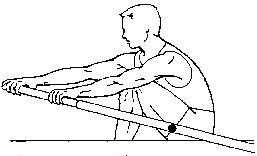
At maximum reach the spoon goes into the water. The back does not rise; only the hands place the spoon in water. The speed of placement is critical. You want you ensure that the optimal place for the catch is not missed. The efficiency of the leg drive will be lost if the spoon is not put immediately complete in water.
First Half of the Drive

The knee angle becomes flatter. After the placement of the spoons in water, the body weight is transmitted on the footboard by use of leg strength. The seat has been begun to move.

The hip angle remains the same. Because of this horizontal power application occurs. The muscles in back, shoulders and arms give back pressure, as a result of which a good link between legs and spoon arises. The torso does not rise.
The arms remains stretched. The outside shoulder has most of the tension.
Second Half of the Drive

The knee angle is almost completely flat. The seat sits on the last quarter of the sliding. The legs are themselves in very efficient position, flat for the last push down.
The hip angle has been opened, the body swing supports the leg drive. The torso is high and (almost) vertical.
The arms are still stretched, and about to start bending.
The oars come almost perpendicular on the boat, and are in a very mechanically efficient position. The body weight hangs still between the oars and the footboard
The Finish and Extraction

The knee angle is flat and the seat is in hindmost position. The legs and back are almost finished. The legs continue push finishing against the footboard, well supportive.
The torso comes in maximum lay-back; the outside shoulder is a little higher than the inner shoulder. The head and the udder are themselves behind the oar.
The elbow angle decreases as the hands approach the finish, outside forarm is horizontal

At the extraction the rower in lay-back position. The hands finish a circle movement down and away, without touching the body.
Grip
Beginners must learn a correct grip of the oar early. A wrong grip causes a lot of errors and is not easily correct. Did not be afraid to invest time in teaching a correct grip for beginners. Teach them how to hold an oar before anything else, Every training session should start with attendtion to the correct grip and rotation of the oar.
Sculling Grip

The scull grip must be relaxed to be with one's index fingers on the end of the handle and the thumb on the end of the handle.
The other fingers have been bent around the grip. The palm is not on the handle and the wrist remains virtually flat, both during the drive and the recover.

Twisting at release and catch happens by use of the fingers, as a result of which the handle ywsts in the fingers. The wrist remains flat.
Sweep Grip

The hands are approximately 2 hand breadths from each other have been put on the oar handle.
The fingers joints have been bent for the grip, with thumbs under the handle.
Both wrists are flat, with the hand palms apart from the handle. The oar must be carried by the fingers, not to be held in the hands.
At extraction the fingers of the outside hand press the handle down. (At sweep rowing the outside arm is most distant from the spoon). The oar is twisted by movement of the inner hand. It is important that the outside wrist remains flat. The outside wrist of the rowers remains flat, whereas the oar in the fingers rotates.
Squaring happens by the fingers and thumb of the inner hand, where the fingers of the outside hand remain around the handle. Twisting the handle, both at catch and extraction, in done by only the inner hand.
The outside hand remains relaxed and flat, as a result of which the rower can rotate the handle in the fingers. The use of the outside hand and arm in the catch is very important, because the outside arm has a longer gearing. The fingers of the outside hand cannot be ' separately ' of the oar. The outside hand and arm must be prepared immediately after the catch to take the pressure.
Blade Work

The blade work has direct consequence on the movement and speed of the boat. For this reason many coaches give more attention on correct blade work than to the body movement. However, the blade work is an direct consequence of what happens in the boat. It is possible for the body movement or the blade work to change and on the other hand improvements to see. An example of good blade work
Recovery
During the recovery the spoon moves in a smooth, horizontal movement toward the bows. The rower must have sufficient space to square the spoon, without touching water.
Squaring for the Catch
Ideally twisting the spoon starts as the hands move over the ankles. Turns must happen quietly, during the last bit of the recovery. It must not influence the horizontal movement of the spoon.
The Catch
The placing of the spoon in water happens rapidly, as a continuation of the recovery. It must be coordinated on the speed of the boat, without much back-splash or front-splash. For beginners however, a small back-splash is advised, to ensure that no water is missed. The weight of the oar does not ensure the catch speed. The placing of the spoon in water, must be followed immediately by the horizontal power application as the blade is covered.
Drive
During the drive the spoon must sit 2-3cm under the water. Because the boat accelerates during the drive, it is important also the handle accelerate, as a result of which the horizontal movement is maintained.
Extraction
The rower must make a smooth, fluent, half-round movement, to get the spoon out of the water. Feathering happens after the spoon is out of the water.
The path of the spoon must be linked both during the drive and the recovery by horizontal movements, and by round movement, as the oars change direction.
The complete movement (turns, catch, extraction and recovery) must related be to the speed of the boat and the tempo.
Summary
The basic rowing technique is a logical, natural movement. There is no space for drastic, abrupt movements which limit the speed of the boat. Body action, blade movements and movements of the seat must be all in harmony with the speed of the boat.
Drills and Word Images
Drills and Word Images Found Effective in Coaching the Four Phases of the Rowing Stroke
Level 2 Technique
Presented by the USOC Development Camp
By J Philip Monkton
==================
The Release
DRILLS
Rowing with one arm only, either inside arm or outside arm
Rowing with blades square to learn downwards pressure needed to extract oar from the water
Rowing half slide
One person rowing in pair oared boat shows effect f dumping finish into the lap
Pick drill with or without feather to develop finish timing
Release and glide
COMMENTS OR WORD IMAGES
Move the pin by the blade
Uncoil the body on the drive
Keep constant pressure on the foot stretcher and the pin throughout the drive and release
Build the speed of the handle during the drive
Drive the hips into the bow
Pry the boat forward
Hang your body weight on the oar to assist in the pulling
The Catch
DRILLS
Row single strokes, starting and stopping over the knees
Pick drill
High stroke pick drill
High stroke paddle
Row with squared blade and catch on coach’s/cox’s command
Intentionally make blacksplash at catch to reinforce blade near water at catch
Outside hand to set the square
Single man rowing in a pair
COMMENTS AND WORD IMAGES
When coach says quicker at the catch it usually means earlier in the stroke cycle
Take the catch as you reach front stops not when
Roll the wrist up at the catch
Balance of the oar makes burying of the oar automatic as oarsman mearly guides the oar in
Pick files off a table
Unweight the hands as you approach the catch
Loop the blade in
Put the blade in a slot in the water
Anchor the blade behind a peg
Don’t kick, push
Make sure that the wheels are still rolling forward when the catch is started
The Recovery
DRILLS
Pause with hands over the knees at extended back position to demonstrate position of body out of bow
Pick drill
Fractional use of slides to develop awareness of control ¼, ½, ¾ slide
Alternate power and paddle strokes to maintain relaxed recovery on power similar to paddle
Ultra slo-mo rowing
Stop on coaches orders during recovery
Row with feet out of stretchers
Stroke play at ¼ power with strokeman raising or lowering the stroke at will
Turn oar full revolution of oarlock during the recovery
Row with eyes closed
COMMENTS OR WORD IMAGES
Let the knees rise slowly
Don’t lift knees until you feel a slight pull on top of thigh behind kneecap
Watch the knees come up
Listen to the wheels on the recovery
Rebound out of the bow
Sit lightly on the seat, feel weightless on the recovery
Keep posture natural
Pivot forward on the cheekbones
Curl out of the bow by doing a sit up
The Drive
DRILLS
Pick drill
Drive with feet out of stretchers
Row single strokes with concentration on the drive
Draw with the outside arm
Accelerate through the drive
Feel the tension in the lower back and hold the back against the leg drive
Pinch the shoulder blades together
COMMENTS AND WORD IMAGES
Move the pin by the blade
Uncoil the body on the drive
Keep constant pressure in the footstretchers and the pin throughout the drive and during the release
Build the speed of the handle during the drive
Drive the hips into the bow
Pry the boat forward
Hand your body weight on the oar to assist in the pulling
Developing a Coaching Philosophy
Developing a Coaching Philosophy
By Steve Mergelsberg, Assistant Men’s Basketball Coach, University of Rutgers-Newark
From http://www.teamarete.com/developingacoachphil.html
--------------
As a new and inexperienced coach, there is much preparation for your first season. Of course, you are excited and eager about your first head coaching position. You most likely have planned what you are going to do and believe that you are ready. But are you truly ready? Have you thought about the how’s and why’s of everything you will do as a coach? It is important as you get started in coaching to develop a philosophy. For that matter, even the experienced coaches may want to reevaluate their philosophy.
Many coaches do not believe in the value of developing a coaching philosophy. They do not realize how a philosophy can have an impact on their daily coaching procedures and strategy. However, a coach’s philosophy is actually a very practical matter. In fact, every coach, aware of it or not, follows certain principles based on their own playing experience. Most of our basic philosophy emanates from former high school and college coaches. This is a natural start, because it is the approach with which we are most familiar and comfortable.
It is also reasonable to assume that the philosophy of a person’s everyday life thinking and actions would be applied by most when it comes to coaching. For example, a salesman discovers that one of his clients is dishonest. He decides to sell to a competitor despite the fact that he will make less of a profit selling the same product. This may not sound like good business practice, yet many people are willing to adhere to their principles even if it meant making less money. How many coaches would stick to principles of sportsmanship or fair play rather than win the game? We can see a gap between what a coach may think is the right thing to do in every day life, and the actions they may end up taking on the field or court.
In your effort to form or analyze you own philosophy of coaching we must first know what a coach is. A coach can be many things to many different people. A coach is a mentor, a teacher, a role model and sometimes a friend. Most of all a coach must be positive. A positive coach has the following traits:
Puts players first:
A positive coach wants to win but understands that he is an educator first and the development of his players is his top priority. He avoids thinking the game is about him rather than the players. Has an unwavering commitment to what is best for the athletes.
Develops character and skills:
A coach seizes upon victories and defeats as teachable moments to build on self-confidence and positive character traits such as discipline, self-motivation, self-worth and an excitement for life. The desire to see the athlete learn and the ability to effectively improve their skill is the key to an effective coaching program.
Sets realistic goals:
Focuses on effort rather than outcome. Sets standards of continuous learning and improvement for the athletes. Encourages and inspires the athletes, regardless of their skill level to strive to get better without threatening them through fear, intimidation or shame.
Creates a partnership with the players:
A positive coach involves team members in determining team rules. Recognizes that communication is crucial to effective relationships with players. Develops appropriate relationships based on respect, care and character.
Treasures the game:
A positive coach feels an obligation to the sport they coach. Loves the sport and shares that love and enjoyment with the athletes. Respects the opponents, recognizing that a worth opponent will push the team to do their best.
There is no level, where as a coach, you cease teaching the game. As long as you teach, teach in a positive manner. You will produce the best players, and ultimately, the best results.
It is extremely important to develop a philosophy with the following statements in mind:
Your approach should be educationally sound.
Your drills should serve a purpose and not merely used for “killing” time. They should be structured to provide the necessary repetition for each athlete and should be relative to the athlete’s ability level.
Your approach should be appropriate for your players.
You may learn a lot of new offenses and defenses and they may be excellent systems, but are they suited for your players? Use an approach that is developmentally appropriate to your players.
Your philosophy must be ethical.
In basketball, for example many coaches instruct players to fake an injury in order to stop the clock. This is unethical. Consider what you do in all aspects of coaching. Coaching from an ethical standpoint is extremely important. Remember, you are a role model for your players
Stick to your philosophy.
Most coaches, especially on the high school level, have to develop the talent on hand. There may be some years in which the athletes may not possess the ability or skill to fit into your philosophy.You cannot change the players, but you can alter your approach.
Is there a better way of doing what you are doing?
Apply this question regarding all aspects of your coaching philosophy-the offense, defense, motivation or your athletes, etc. Keep an open mind. Learning should be a life-long pursuit and this should definitely apply to your coaching philosophy.
Explain why you do the things you do.
To instruct and to motivate your athletes, you have to justify what you do. Can you? You better be able to.The days of just simply saying, “Well, this is the way we are going to do it,” are long gone. There is no way that you can justify anything associated with your program or team to athletes and parents without an explanation.
Your coaching philosophy should be compatible with your personality.
Are you a risk taker? Patient or impatient? Deliberate or aggressive? You will be more successful if your philosophy and personality are both in sync.
Sportsmanlike conduct should be a top priority involved with your philosophy.
There are certain situations in some games, which could be considered unsportsmanlike by opponents, officials and fans. Running up the score, playing starters long after the outcome has been determined and taunting are just a few examples to be considered. If any of these exist within your approach to coaching, you may have to make some changes.
After analyzing all the factors that I have mentioned, develop your own philosophy by putting it into written form. It is extremely important to be able to express and to explain your approach to athletes, parents and supervisors. A written document can also give you something concrete to reexamine and to evaluate annually
The Danger in Knowledge
Coaching Development – The Danger in Knowledge
By John Leonard
From http://www.swimmingcoach.org/articles/news.htm
-----------------
Knowledge is an interesting concept. In the Websters New Dictionary the word "know" is defined as:
1) To perceive with certainty; to understand clearly;to be sure of or well informed about. As, we KNOW the facts.
That's the preferred definition. Hmmmm. "To perceive"".... Lets look at perceive.
2) to take hold of, to feel, to grasp mentally,to recognize, to observe. To become aware of.
So, to KNOW something is to perceive it with Certainty. And, to perceive it is to feel, hold, grasp it, recognize it.
So what you know, is what you perceive?
What if what you perceive is limited?
Ø Limited by looking through a microscope at the cells of a whale.
Ø Limited by standing in Manhattan, and looking at the Statue of Liberty.
Ø Limited by listening to only one source.(What if Eddie Murphy was the only person to listen to?
Ø Limited by reading only one opinion.(What if you could only read Rush ?)
Ø Limited by seeing only one quality swimmer.(What if you ONLY saw Janet Evans swim freestyle?)
Ø Limited by only one source for scientific information?(Chinese/East German athletic system?)
This is scary.
Back in 1980, there was an article in Time Magazine that noted a small footnote of a disease found in Haiti that debilitated the immune system of black male homosexuals. The article assured us that there was no danger to any other population.
In 1982, TIME printed that the disease had spread and now, only male homosexuals were at risk. Everyone else was ok. No worries, unless you were a male homosexual. In 1985, TIME's story was that homosexuals, male and female were at risk. No one else need worry.
In 1986, TIME said there was evidence that it was spread through the blood. (and the blood supply for those who had transfusions. No one not homosexual or in need a transfusion need worry.
Then they added that well, maybe a few heterosexuals might have IT also. Then they finally noted that well, yes, it did appear that it was sexually transmitted, as well as blood borne. Now, you note, AIDS is the scourge of the century, with no cure in sight. But in 1980, we KNEW that only black male homosexuals could get it. No worries. Scary. Now, remember, they are absolutely sure that mosquitoes can't carry aids. I'm reassured. How about you?
What does this have to do with swimming?
A lot. One thing that most of us have in common when we start to coach, is that we want to do a good job. To do a good job, we are convinced we have to KNOW something. I read Doc Counsilman's early books, and was absolutely certain that I KNEW that action-reaction was what produced forward propulsion, and anything other than that was a waste of time. And I vigorously fought for that stroke with my swimmers, and with my assistant coaches. Then I met an engineer who talked about funny things like "lift" and Bernoulli's Principle and things...and I thought he was crazy and kept on teaching what I KNEW as correct.
Five years later, Doc and many other people decided that LIFT and Mr. Bernoulli and his principle was the main thing. (And Doc told us, repeatedly, to "QUESTION EVERYTHING", and we thought he was just being modest.) So I learned and KNEW that the new paradigm of lift was "the Answer". Now I am reading material that says that at certain speeds, the Action/Reaction Drag force is the only way to move fast enought. Hmmm....
Yet many of us insist on "knowing" something. And once we have that "perception" of "knowledge", it becomes deeply a part of each of us. We defend what we know with vigor, enthusiasm, and a touch of....desperation? Why? Because we value, and we hope others value, something called knowledge. If we actually "know" less, we are therefore, worth less. (or worthless?)
When I was a young coach, with no achievements behind me, and a very challenging world in front of me, my "knowledge" was all I had. The same is true for many coaches today. Yet that very knowledge, so precious to us, keeps us from doing the very best job we can do as coaches. That's what makes Knowledge dangerous. Coaches are good salespeople. We sell ideas to our swimmer and parents daily. We are selling our "knowledge". (Gulp)
Because its not really KNOWLEDGE in the sense we think of it. Its not TRUTH. Not permanent. Not inerasable. Its changeable. Its a product of perception. A product of what we see, hear, sense, "hold", smell and taste. To KNOW is simply to PERCEIVE. And perception, by definition is faulty.
How do we think we acquire KNOWLEDGE? By Education. Does this put Education in a bad light? Not if the Educational process presents its material in the correct light. What is the correct light? Its INFORMATION. Its what we perceive about a subject right now. As we get a bigger and better microscope, we get more information about the real size and scope of the whale. If we turn around we see a city, rather than a metal lady standing in a bay. We hear Jesse Jackson as well as Eddie Murphy, we read liberals as well as Rush, we watch Matt Biondi and Popov as well as Janet Evans. We get our science from ICAR, from Universities, as well as from the Chinese and East Germans. We want information from many sources.
In short, we gather INFORMATION. And we put it into our coaching TOOLBOX. One of my favorite expressions is "If you only have a hammer, everything looks like a nail." No one tool can address every project or problem. Anyone who builds can tell you that having the right tool is 90% of doing the job the best way possible, with the best result.
Our task as coaches is to build our toolbox. Without getting married to our saw, or our planer, or our chisel. No one idea, no one coaching method, no one stroke mechanic principle is "the tool" for everyone or every problem. We have to gain the set of tools necessary to do the job in each situation which we face. And that takes time, and experience.
The same materials go into your coaches Toolbox, as into your KNOWLEDGE, but you recognize that everything is simply information, and it can ALL be useful. Its up to you to apply the information that you acquire. And you don't learn ONE WAY of solving a problem, decide that you KNOW how to solve that problem from now on, and never look for new tools. There is no one way to build a team, win a national championship, teach a stroke, or a start or turn, plan a workout, plan a season, recruit a swimmer. There are many ways for every task, and they will all work well for someone, in some situation.
First, clear your mind of "Knowledge", then, fill it with information. The information forms your toolbox, and your experience will tell you what tool to use to solve each problem.
The older I've gotten the less I know. But the more experiences I've had, and more information I've touched...maybe not "held" exactly, but touched.
Doc Counsilman was right. Question Everything.
And I'll add, Put It In Your Toolbox.
And expand your toolbox at every opportunity.
Musculature Used In the Rowing Stroke
Anatomy – Musculature Used In the Rowing Stroke
From Thompson, C.W. & Floyd, R.T. (1994) Manual of Structural Kinesiology. Mosby, USA.
------------------
The Drive
Foot and ankle
Plantar flexion
-Gastrocnemius
-Soleus
Knee
Extension
-Rectus femoris
-Vastus intermedius
-Vastus lateralis
-Vastus medialis
Hip
Extension
-Gluteus maximus
-Biceps femoris
-Semimembranosus
-Semitendinosus
Trunk
Extension
-Erector spinae
Shoulder Girdle
Adduction and Depression
-Trapezius
-Rhomboid
-Pectoralis minor
Shoulder Joint
Extension
-Latissimus dorsi
-Teres major
-Posterior deltoid
-Teres minor
-Infraspinatus
Elbow Joint
Flexion
-Biceps brachii
-Brachialis
-Brachioradialis
Wrist and Hand
Flexion
-Flexor carpi radialis
-Flexor carpi ulnaris
-Flexor digitirum profundus
-Flexor digitorum superficialis
-Flexor pollicis longus
The Recovery
Foot and Ankle
Dorsal flexion
-Tibialis anterior
-Extensor hallucis longus
-Extensor digitorum longus
-Peroneus tertius
Knee
Extension
-Biceps femoris
-Semitendinosus
-Semimembranosus
Hip
Flexion
-Iliopsoas
-Rectus femoris
-Pectineus
Trunk
Flexion
-Rectus abdominus
-Internal oblique abdominal
-External olique abdominal
Shoulder Girdle
Abduction and Elevation
-Shoulder girdle adductors and depressors (eccentric contraction)
Shoulder Joint
Flexion
-Shoulder joint extensors (eccentric contraction)
-Deltoid
Elbow
Extension
-Triceps brachii
Wrist and Hand
Extension and Flexion
-Hand flexors (eccentric contraction)
-Extensor carpi ulnaris
-Extensor carpi radialis brevis
-Extensor carpi radialis longus
Saturday, December 1, 2007
Olympic Marathon – Anatomy of a Medal
Olympic Marathon – Anatomy of a Medal
By Joe I. Vigil, Ph.D.
Olympic Event Decision
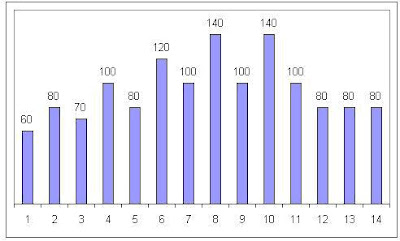
Upon consideration of all the negatives and positives of the geophysical conditions we would encounter in Athens, 11 months prior to the games, Deena decided on the Marathon. I believe she could have done as well had she selected the 10000 meters, but her choice proved to be a wise. We began by running Olympic Trials for protection against injury. This way she would be assured of making the Olympic Team. She decided to dedicate 11 months to the best and most difficult training she ever had, as well as competing a minimal number of times. The focus for the year was to medal in the Marathon. She, along with her three training partners, Colin Steele, Joe Eckerly and Derek Tate, put together 14 weeks (See Table 1) of excellent training that produced a fitness level she had not previously experienced.
Table 1.This table illustrates progression in weekly volume. It can be utilized by more experienced marathoners who can handle the increased volume.
Critical Zone Training
Critical Zone Training (CZT) is a phrase coined to identify training requirements for success at the Olympic Games, World Championships or specific high quality events. The training demands are specific to the event and incorporate the times athletes must achieve in practice to be able to compete at the above levels.
By Joe I. Vigil, Ph.D.
---------------
One of the most compelling success stories of the Athens Olympics was the performance of the U.S. Team in the Marathon. These outstanding performances were the result of not only exceptional talent and discipline on behalf of the athletes, but impeccable planning and application of 21st century sports science.
This article deals not only with the application of science and training methodology, but also the athlete/coach interrelationship, vital for the success in any athletic endeavor. Although Team Running USA had two medalists in the Marathon – Deena Kastor (Bronze) and Meb Keflezighi (Silver), this article will deal with the specifics of the training progression of Deena Kastor.
This success was not an overnight achievement. It started 20 years ago when Deena’s involvement in age group athletics first started. From the very beginning, she showed signs of things to come. After winning several California state high school championships, she enrolled at the University of Arkansas. Her collegiate career was good but not exceptional. She earned several “All American” recognitions in both Cross Country and Track & Field, but she never won a national championship. The outstanding talent she displayed as a high school runner was never realized in college.
I first met Deena when she competed for the U.S. Jr. Cross Country Team in the World Championships in Aix Le Baines, France. In our first meeting, we developed an instant mutual respect. I learned that at the completion of her University of Arkansas studies, Deena found herself with a burning desire to continue her training. Like most, she dreamed of one day running in the Olympics and, at the urging of her Arkansas Assistant Coach, Mylan Donley, she contacted me. At first I was reluctant to work with her, but her persistence, hunger for high goals, and willingness to relocate to Alamosa, Colorado (7543¢ altitude) persuaded me to take her on. Hence, a team was formed.
Qualities Necessary for Success
I believe it was the best professional move either one of us has ever made. Her accomplishments the last eight-ten years (1996-2005) have been spectacular. The qualities necessary for this level of success and the progression of her physiologic profile came at a great price.
As with all members of Team Running USA, we required that all athletes strive to:
Improve Personal Relationships
Improve Achievement Motivation
Improve the Quality of Their Mini and Macro Environments
Improve Their Athletic Maturity
Show Integrity to Their Value System
Display a Commitment to Their Mission
Practice Abundance by Giving Back to Their Sport and Team
If I were to operationally define the qualities an athlete must possess to be successful, Deena would epitomize those qualities. She is a great example of mind/body autonomy working in harmony to reach set goals. She truly believes and adheres to the principle of unending improvement and the setting and achieving of even higher goals.
Increases in Volume
Knowing that I had an athlete willing to go the extra mile, we started working on the physiologic variable that would allow her to compete at the international level. Previously, she was only running 40-50 miles a week, which certainly was not enough volume to compete at her desired level. We increased that volume to 70 miles per week (MPW) for the next 15 months. This allowed for gradual adaptation without any resulting injuries or setbacks. At this point, she had a VO2 MAX of 70.2 mls. (VO2 MAX is the maximum amount of oxygen in milliliters your body can use in one minute per kilogram of body weight, i.e. the higher the better). We next increased her volume to 90 miles a week over the next 18 months. Her VO2 MAX jumped to 77.5 mls. During this time period, she was making her mark nationally and had won a national championship in Cross Country. Again, we increased her volume to 100-110 miles per week and, not surprisingly, her VO2 MAX was at 81.3 mls. This level of fitness is attained by very few athletes and is one of the highest ever recorded in an American athlete.
Presently, we maintain an average of 100 mpw ±10 and adjust that volume in accordance with the competitions she will enter. The volume can be as low as 70 mpw for track races to 140 mpw for a marathon. Because of our precise planning, she handles this volume manipulation very well.
We both knew VO2 MAX was important, but even more so was the increase of anaerobic threshold (AT - the point at which lactic acid starts to accumulate in your muscles). Since this became an important training objective, we incorporated the AT runs, sometimes referred to as tempo runs. We started with four miles and over a period of time, increased to six, eight, and ten miles. If we were preparing for a marathon, she would run 12-13 mile AT runs. We thoroughly believed that the longer the run, the greater the stress, the greater the consequent adaptation.
A noticeable observation was made over the five-six year period of increased volume; her AT velocity increased profoundly. She went from an initial 5:24 per mile pace to 5:11 to 5:01. I would like to state that volume runs, when combined with a regular diet of AT runs, are the most important workouts for the development of the endurance component. This brought about a profound increase in her running economy.
Equipped with these two remarkable qualities (increased VO2 uptake and increased anaerobic threshold), any athlete can then embark on running and competing at the international level. We must keep in mind that these increases were brought about through gradual adaptation to stress. As we worked together on a day-to-day basis, Deena learned to listen to her body and knew exactly what her perceived exertion was at a given pace.
Training Priorities
After each human performance test, we had accurate information on her velocity at VO2 MAX (vVO2), anaerobic threshold velocity (ATV), lactate max, lactate at threshold, max heart rate (HR Max) and heart rate at threshold velocity. Armed with this information, we got her vVO2 (which was 4:27 for the mile). This figure would help us in determining her goals for the 3000, 5000, 10000 and the Marathon. We also determined that her fractionalization (VO2 at threshold velocity divided by VO2 MAX) was a percent we would like to improve. We followed the protocol below in determining goals:
3000 Meters 7-12 Minute Effort 100% vVO2
5000 Meters 13-17 Minute Effort 95% vVO2
10000 Meters 26-38 Minute Effort 90% vVO2
Marathon 2:06-2:30 80-85% vVO2
This information was deemed extremely accurate, as Deena was only off two seconds in her AR in the 10000 and Meb1.93 seconds in his 10000 AR. After determining their fractionalization (Deena 83% and Meb 81%), we established their goals for the Marathon. Again, Meb missed it by only three seconds and Deena by only 1 minute 16 seconds. Our objective for the future will be to increase fractionalization by utilizing volume and AT runs at the appropriate distance and velocity.
Altitude Training
The record has shown that since 1968, 95% of all Olympic and World Championship medals from the 800 through the Marathon were won by athletes who lived or trained at altitude. It can therefore be concluded that altitude training is necessary for success in endurance events. I have lived all my life at altitude in Alamosa, Colorado (7543¢) and it was easy for me to become a true believer in altitude training. The observations I have made and my background in physiology has shown me that there is a distinct advantage to altitude training.
Over the past 30 years, I have hosted individuals and entire federations for their altitude training. The successes include World records, Olympic medals and personal bests. Most of the distance running world has bought this philosophy. It has, however, been difficult to convince most American coaches and athletes, though there are a few that believe.
When Team Running USA was organized in 2000, Bob Larsen and I were hired to run the program. We both believed in altitude training and incorporated three-four altitude training blocks of one month or longer in our annual training plan. We selected Mammoth Lakes, California (8000-10,000¢) as our official high altitude training camp. We also tried to hold our camps prior to major events so they could go down to sea level with the greatest amount of oxygen carrying capacity possible.
Deena had spent four years (1996-2000) in Alamosa when we made our move to Mammoth Lakes, CA. The next four years (2001-2005) gave her a greater adaptation to altitude and she was capable of training at even high altitudes (9000¢), which she did frequently. On occasion, we would go to sea level to train at ARCO OTC in San Diego. This was also the site for all of our testing protocols. We were, however, altitude-based the majority of the time.
By living and training at altitude, athletes expect to get an increase in their red blood cell mass and hemoglobin, which enhance the athletes’ oxygen carrying capacity. These factors allow the athlete to perform and train more effectively upon return to lower elevations.
Olympic Event Decision
Upon consideration of all the negatives and positives of the geophysical conditions we would encounter in Athens, 11 months prior to the games, Deena decided on the Marathon. I believe she could have done as well had she selected the 10000 meters, but her choice proved to be a wise. We began by running Olympic Trials for protection against injury. This way she would be assured of making the Olympic Team. She decided to dedicate 11 months to the best and most difficult training she ever had, as well as competing a minimal number of times. The focus for the year was to medal in the Marathon. She, along with her three training partners, Colin Steele, Joe Eckerly and Derek Tate, put together 14 weeks (See Table 1) of excellent training that produced a fitness level she had not previously experienced.
Table 1.This table illustrates progression in weekly volume. It can be utilized by more experienced marathoners who can handle the increased volume.
Critical Zone Training
Critical Zone Training (CZT) is a phrase coined to identify training requirements for success at the Olympic Games, World Championships or specific high quality events. The training demands are specific to the event and incorporate the times athletes must achieve in practice to be able to compete at the above levels.

The average times in the Marathon for the previous four Olympic Games and five World Championships were 2:26:45 for First, 2:27:34 for Second and 2:28:16 for Third. Our goal was to medal, so we had to train to achieve these times under all conditions. The topography of the Marathon course in Athens is shown in Figure 1:
Figure 1: Profile of Athens Olympic Marathon Course
One can observe the torturous eight-mile incline from 18000 meters to 31000 meters. I found a very similar course close to Mammoth Lakes, where nearly all aspects were identical. The one difference was that it was at 7000-8000¢ altitude. We ran it seven times prior to Athens at a pace that was altitude-adjusted. The course in Athens presented no psychological barrier for Deena.
To meet the extreme demands of heat and humidity, we did three things:
We wore extra clothing in practice.
We practiced on fluid intake on our long runs every 15 minutes for 11 months.
We went to Crete two weeks prior to the Games to acclimate to the heat and humidity.
While training in Crete, we encountered extremely hot weather, always around 98°-104°F. We adjusted our workouts by running hard early in the day and easier in the late afternoons. As the days passed by, we progressively moved the intense workouts toward the time that the Marathon was going to be contested. Crete is in the same time zone as Athens, so our circadian rhythms had 14-17 days to adapt to the time zone of the competition. Constant reinforcement in hydration, rest and diet was carried through to the end.
As expected, the temperature at race time was 102° (120° asphalt) and 54% humidity at 6pm. As with other marathons, Deena knew she was going to have to exercise complete emotional control throughout the race. This is a quality she displayed beautifully, as the race results indicated.
Deena’s support team included her husband, Andrew (Physical Therapist) and three training partners. In Figure 1, the last 14 weeks shows her volume and taper prior to the race. The daily sessions of ancillary work (core, plyometrics, strength, flexibility) and agility drills over a number of years made her an exceptionally well-prepared athlete. Our specific training program consisted of the following training intensities:
Training Intensities
Basic Speed/Power: From 60 to 100 up to 400M speed endurance. Below 200M, all out at 300-400M race pace early. Then pick up pace with each repetition. This workout aids in the development of running form, running mechanics and event-specific running economy.
Lactate Threshold: Training runs of 20-60 minutes at 85-87% of HR or 85-87% of vVO2 aids in developing a high level of aerobic threshold.
High-End Aerobic Endurance: Endurance training at 70-80% of maximum HR or 75-80% of vVO2. The duration of runs should be 30 minutes to three hours. The runs should be on soft surfaces and hills. Negative split effort is most desirable.
MVO2: Development of maximum volume of oxygen at 90-95% HR or 90% of vVO2. Three minutes to eight-ten minute duration or repetitions of 800, 1K, 2K and 3K. We use two minute intervals between repetitions at sea level and three minutes at altitude. These runs develop peripheral training adaptations, increase fat metabolism, increase concentration of aerobic enzymes, mitochondria and capillarization.
Recovery: Low intensity runs 25-30 BPM below lactate threshold HR. The runs are from 45 minutes 1 hour 20 minutes and can be run both in the AM and PM. It promotes recovery following high intensity workouts. This run energizes the athlete for the next hard workout.
It is extremely important that the athlete and coach orchestrate the Five Training Intensities so they have proper recovery and maintain enthusiasm for the challenges to come. Table 2 exhibits the plan we employed:
THE RACE
I was not able to go to the starting line because of the traffic and crowd controls. In my last conversation with Deena before race time, she confided in me and said, “I have done every workout you have prescribed over the last seven months. I feel fitter than I have ever felt and I am confident that I will medal today.”
Along with her many supporters, I went to the historic Panathinaiko Stadium, home of many famous marathons, to watch the race unfold. As I sat and watched, I recalled all her training sessions throughout the previous 11 months as well as her volume (40,000 miles of training) the previous eight years. I, too, was confident she would medal. We watched on the giant TV screen as she moved progressively from 28th position to 3rd, running courageously, methodically, with confidence and emotional control.
To work with an athlete of the caliber of Deena Kastor comes once in a lifetime, and I have enjoyed every minute of it. Her Bronze medal was certainly a highlight of the Games for the American Team and legions of American distance runners back home. The biggest impact into the future will be the courage, the work ethic, her passion for the sport and the leadership she displayed on her memorable journey.
This showed that Americans, with proper training, are as good as any runners in the world. Young American runners in their developmental stages will try to emulate her and now know that their dreams and visions are realistic and possible, for they too can medal in the Olympic Games. Thank you, Deena.

Subscribe to:
Posts (Atom)